«There’s a pretty big difference between wanting something and deciding to have it.»
Scott Adams
The framework makes your creative system visible.1 This allows you to run low-threat trials of different behaviors in order to see which ones actually improve your creative work.
Because the framework is non-linear, you can begin improving it anywhere. For example, you might start with an aspiration (see Creative Direction on page 149), with a specific project (e.g., a bachelor’s thesis), with a few ideas (e.g., plot and character ideas that could become a novel), or with your knowledge and skills (e.g., learning about a domain such as music or improv in order to be creative in it). The framework invites exploration. And if you want to improve a specific aspect — e.g., generating more ideas or capturing more reliably — you can start there.
For example, suppose you want to be creative in music. You can start by improving your capabilities (Foundation), writing a particular song (Project), developing ideas for songs or performances (Ideas), or clarifying your aspiration (Creative Focus), e.g., to make a some kind of music great again.
If your creativity falters, say you cannot seem to finish the song, you can trace the issue. Is it in the Project itself, for example lack of time or fear of feedback? In Creative Focus, for example too many competing projects? In Ideas, for example no ideas in the collection, too few ideas captured, or no idle time for generation? Or in the Foundation, for example insufficient capabilities or an environment toxic to creativity?
Once you have identified a likely reason, you can treat it as a hypothesis and test it. For example, schedule a day or two to work on the song. You might be right — the chances are good. If not, you can try something else. This can be a different intervention for the same hypothesized cause, such as defending some time each day, or it can mean addressing a different possible issue. The system gives feedback on whether you are correct — here, progress in songwriting.
In practice, because creative work is a system, you rarely change only one thing. Most changes affect other parts of the system as well. For example, if you generate more ideas, you will likely also need a better way to capture them, and your collection must be able to handle the influx. It may also become harder to stay focused on the project you are currently realizing if the new ideas belong to another project and look very promising.
Thus, the suggested approach is to treat your creative process as a system you can debug:
- make your system visible,
- diagnose it (underflow, optimal flow, overflow),
- intervene if needed (run local trials),
- reflect on the system effects (what changed), and
- over time, strive for an equilibrium that supports long-term creative output.
This way, you improve your existing system while continuing to use it.
1. Orientation: Make Your System Visible
You already have a creative system. It may be well designed, or it may rely on ad hoc organization — a drawer full of idea fragments, avoidance patterns as a prioritization rule, or memory as the default storage decision for ideas.
But it is there.
The next chapters examine the respective areas and elements. As you read them, you can use the ▯ Creative System Map (see Figure 2) to write down how you usually handle these aspects. Your system is already shaping your creative output. Mapping it makes it visible and helps you identify what works, where friction occurs, and what could be improved.
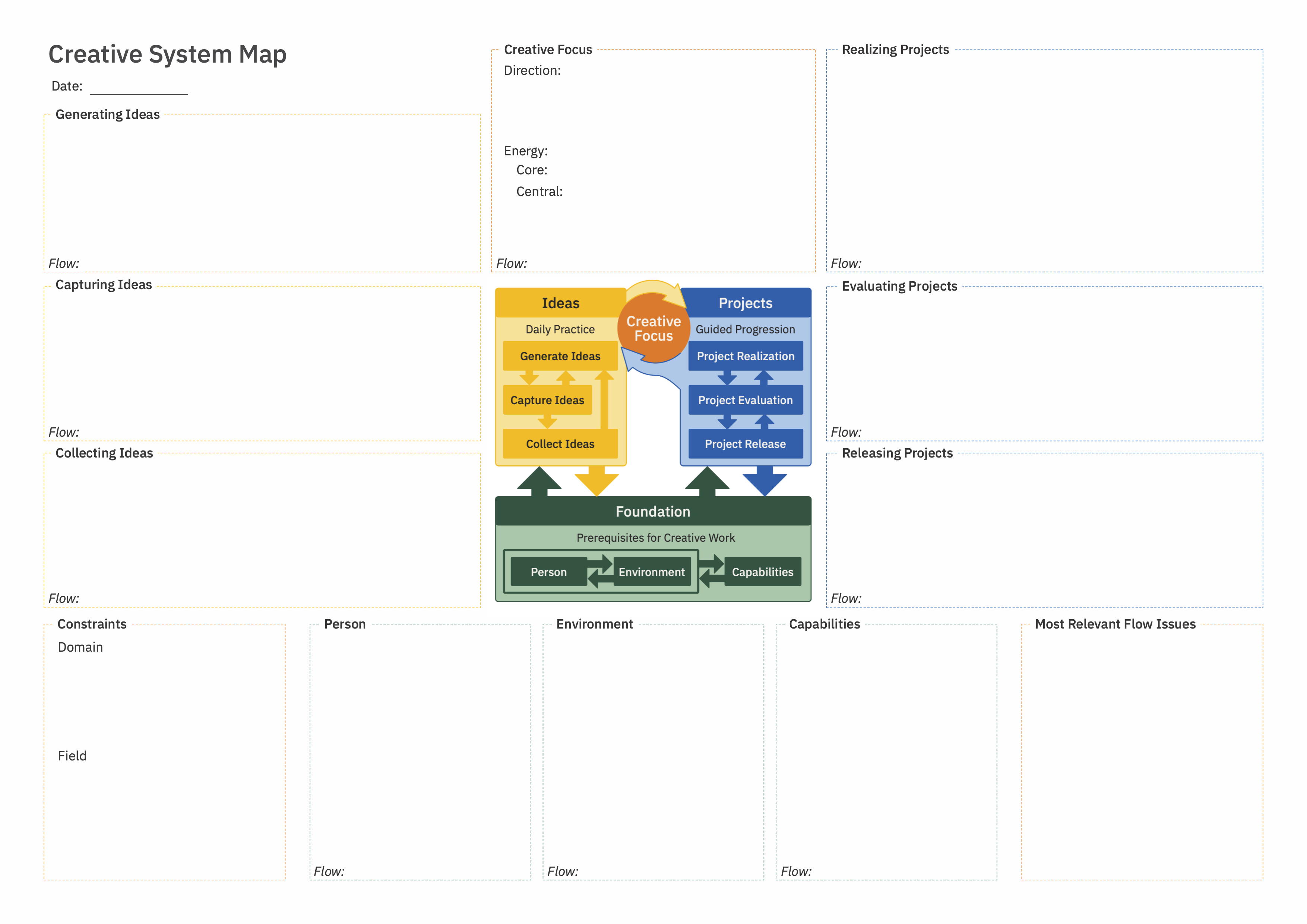
Figure 2: Creative System Map. You can find it online at https://www.organizingcreativity.com/oc3/ws
For example:
- Foundation: What knowledge, skills, and habits enable your creative work? Which do you struggle with?
- Ideas: How do you generate, capture, and collect ideas? How good are the ideas you generate?
- Creative Focus: How do you decide which projects to focus on? Do you stay with them? What do you want to achieve long-term?
- Projects: How do you realize creative projects? Where does realization fail, and why? How do you evaluate them? When and how do you release them?
Taken together, this should answer questions such as: «Where do ideas currently land?», «Where does creative work stall?», and «Where does work actually move forward?»
If you are unsure how you really behave in practice, just observe yourself for a while. For example, each time you produce, lose, postpone, or develop an idea, briefly note what happened and where. If you have never examined your system before, your reaction might be something like: «Oh. I am already doing all of this — just not as well as I could, and without consciously deciding what works best for me.»
Accuracy matters here — what do you actually do, not what you think you should do or could do. In some cases, that will look messy and then that is exactly the right thing to externalize. The point is to anchor change in what you are already doing. Designing a new system on a drafting board usually fails because it is not connected to daily life.
If ideas for changes occur while mapping the terrain, write them down. But map the full system before deciding what to change, so the decision is informed. Likewise, do not yet evaluate whether a given element works well or poorly. Look at the wider context. Something that is merely annoying may matter much less than a real and perhaps «boring» bottleneck. Worse, you might change something that looks weak locally but works well in the system overall.
2. Flow Diagnosis
Making your creative system visible should reveal what works well and what you might want to improve. Ideally, each element is in equilibrium — optimal flow. However, underflows and overflows can occur. Table 4 and Table 5 provide examples of all three states, further examples are at the end of the framework chapters.
| Underflow | Optimal Flow | Overflow | |
|---|---|---|---|
| Foundation | |||
| Person | low energy, low meaning, fear of exposure, weak follow-through | enough meaning and energy to engage; realistic confidence; workable discipline | overidentification with the work, perfectionistic overcontrol, compulsive effort, grandiosity |
| Environment | little protection, little support, constant interruption, weak infrastructure | protected time, workable tools, enough support, environment fits the work | too many demands, too much input, too much social pressure, too many opportunities competing for attention |
| Capabilities | knowledge or skill too weak for the intended work | sufficient knowledge and skill for the current level of work, with room to grow | endless learning without application, tool-chasing, option paralysis from too many possible directions |
| Ideas | |||
| Generate | too few ideas, blocked or dried up | steady stream of usable ideas | too many ideas, too fast, distracting from execution |
| Capture | ideas are missed or lost because capture is absent or too slow | promising ideas are captured quickly and reliably | everything is captured, including low-value material, which breaks flow or creates clutter |
| Collect | ideas are scattered, inaccessible, or too thinly developed to use | collection is searchable, usable, and supports ongoing work | the collection becomes a hoard, or an end in itself |
Table 4: Examples of underflow, optimal flow, and overflow across the main areas and elements of the creative system (part 1).
| Underflow | Optimal Flow | Overflow | |
|---|---|---|---|
| Creative Focus | |||
| Direction | no clear center of gravity, hesitant exploration | clear direction without rigidity | locked into a specific path, inability to abandon projects, overscheduling |
| Energy | weak prioritization | one core focus with a few peripheral explorations | too many competing centers of gravity, constraints strangle creativity |
| Commitment | cannot commit, delays starting, keeps circling possibilities | commits to the right project at the right time | commits too quickly, too often, or to too many projects at once |
| Projects | |||
| Realize | sporadic effort, poor continuation, project repeatedly stalls | sustained progress, good continuation, manageable friction | perfectionistic overworking, uncontrolled scope expansion, burnout |
| Evaluate | evaluation is avoided, delayed, or ignored | evaluation is timely, useful, and improves the work | overanalysis, fixation on comments, constant reevaluation, paralysis |
| Release | release is postponed indefinitely, work is withheld out of fear | work is released deliberately, at the right level and in the right place | premature release, oversharing, compulsive publishing, repetitive self-promotion |
Table 5: Examples of underflow, optimal flow, and overflow across the main areas and elements of the creative system (part 2).
While overflow may sound like a good problem to have, it can severely cripple creative output. Depending on where it occurs, you may become paralyzed by choice, finish nothing, or become so flooded with ideas that you can hardly do anything. It also tends to disrupt sleep and leads to burnout quickly. The ideal is sustainable creative output — neither too little throughput nor too much — across all elements.
It may be tempting to change the whole system. But identifying the main bottleneck or flood area makes it much easier to see whether a change actually improves creative output and whether it can be sustained.
Think of the creative process as a system with leaks and burst pipes. Start there. The aim is a system that is at least good enough in all areas and elements while you continue creating.
Diagnostic Question 1: What is the main limiting factor, or what has most clearly gone out of bounds?
Where does output reliably decrease or stall? Where does it flood the system and need to be reduced? Put differently, what is the largest pain point that most strongly impedes your creative work?
This may not be the place where improvement sounds most attractive, e.g., the overflowing drawer, the lost notes, or the stalled project. But it has to be real — something you are actually doing now.
Diagnostic Question 2: What causes the underflow or overflow — where is the problem situated?
Sometimes the cause is obvious. For example, if you do not capture ideas despite having them, the problem is usually that capturing needs to be improved. But diagnosis can also be tricky and may require tracing the flow more carefully. Perhaps you do not capture ideas because you are in an environment where creativity is not actually valued — so why bother preserving ideas that will go nowhere?2
Non-events are even harder to notice. For example, you may struggle to choose which projects to realize, and a mentor might help. But while conflict with an existing mentor is easy to notice, not having one — and therefore not even noticing that mentorship would help — is often overlooked.
This systems perspective can be a relief. It helps you see that the issue may not be «motivation» or «disorganization» in general, but a specific element — e.g., underdeveloped capturing — that is holding you back. Something concrete that can be improved.
3. Intervention: Run Local Trials
Once you have identified a major point for improvement and a likely cause, you can test your assumptions — change one thing and monitor the outcome. The book chapters, and the more specific supplemental materials, will give you starting points.
However, while reading, planning, and even having insights are comparatively easy, changing behavior in a way that actually improves something is not.
- Your life is a system: Many parts of life influence each other. Work affects sleep, sleep affects mood, mood affects what you take on. Things change whether you plan for them or not, and you never see the whole picture clearly. So no element changes in isolation, and outcomes often differ from what you expected.
- Time is limited: Most days are already full. Adding a new behavior usually means taking time or energy away from something else. Every change is therefore also a decision about what not to do.
- Life gets in the way: Even well-intended changes compete with deadlines, illness, social obligations, and ordinary bad days. Without structure, intentions are easily forgotten or misremembered.
Taken together, reading something once or making a one-time effort rarely changes behavior for long. To see whether an insight can actually fit into your life, you need to test it under real conditions.
This is necessarily a long-term process. Setting calendar reminders — for example, every two weeks — can help you stay with it. Otherwise, life gets in the way and attempted changes are easily forgotten. Once reminded, you can also look at how well it worked or, for example, what crowded out the attempt, and deal with that.
While there is much that could be improved, small, iterative changes are usually better than a complete system overhaul. These small changes, e.g., trying a different capture method or changing the workplace setup, survive contact with reality better, because a single change can be implemented quickly and you see its effects faster and more clearly. You are also not destabilizing your entire prior system or putting it into question, which could feel threatening. Nor do you need elaborate instructions or checklists about what to do when — just simple reminders.
Small changes also allow you to continue working while you try them out. You just determine what you want to try out and do it for a while, e.g., a few weeks, while continuing your creative work. Otherwise, trying to improve your creative system distracts too much from actually doing creative work.
Changes must not destroy what already works well or what is generally needed for creativity.3 A major example is fallow time or idle cycles, which are easily «optimized away» and whose loss then undermines creativity in the long run (see Defended Time on page 83).
Some improvements have to be made indirectly, e.g., trying to improve inspiration and insight. They are second-order phenomena that often collapse under too much observation or evaluation. What helps is to create the conditions they require — often free activation or idle cycles — and then leave them alone. That is tricky, because you cannot, for example, go for a walk in order to have insights. You need to make walking — without podcasts or music, so idle cycles remain possible — part of your daily routine.
Because these changes are time-limited and produce feedback, you do not need to get them right on the first attempt. You will find out whether you were right once you test them.
Because meaningful trials are not trivial, the ▯ Integration Worksheet was designed to support exactly this step: turning insights into behavioral trials. It contains more information on designing a trial, common failure modes, examples, ways to learn across multiple trials, and a form sheet (see Figure 3).
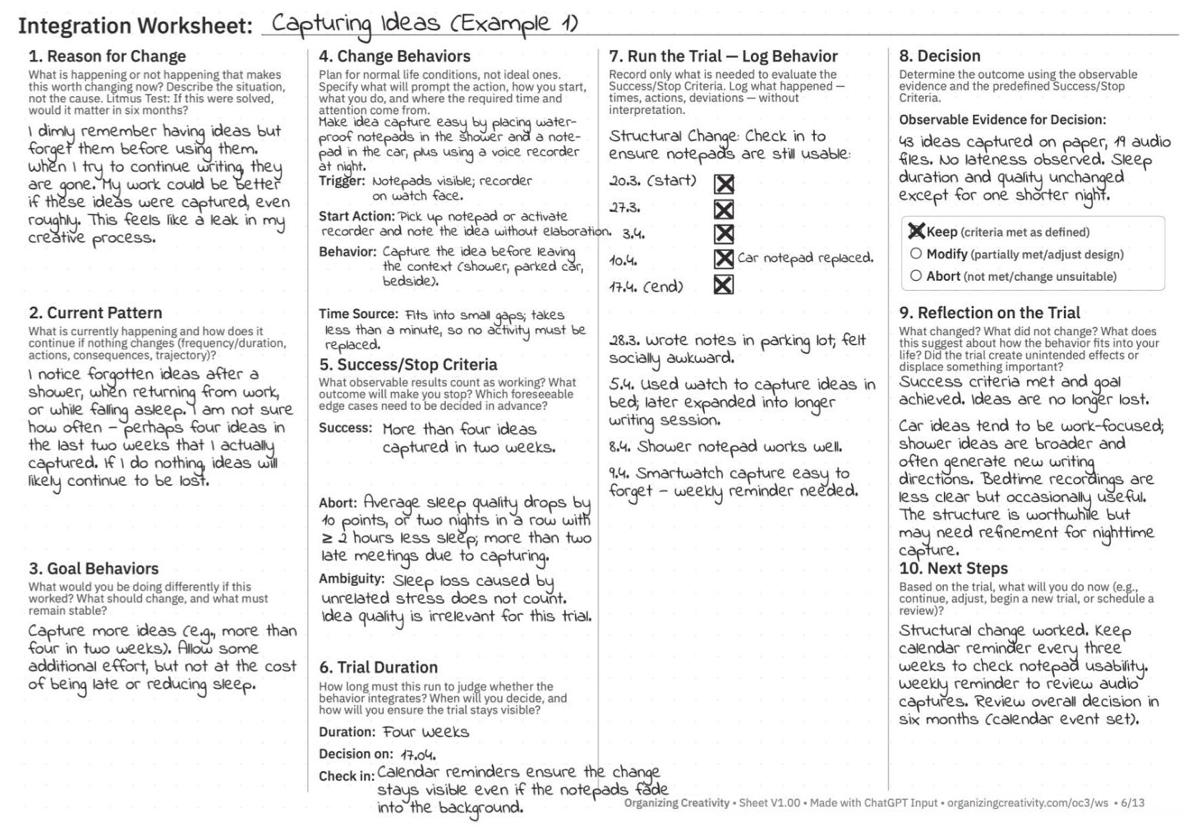
Figure 3: Example of an ▯ Integration Worksheet Form with the aim of improving idea capture. The approach uses environmental design (notepads/smartwatch available for capture) with a bounded experiment (4 weeks) and irreversible evidence (sheets with ideas/audio files). See the Integration Worksheet for more information: https://www.organizingcreativity.com/oc3/ws
In brief, you define what you want to try and how you will recognize success or failure, run the trial for a limited time, look at what actually happened, and then decide what to keep, modify, or abandon. Most changes require several iterations before you find a version that truly fits — or discover that it does not.
This approach has a strong behavior focus, which fits the definition of creativity as the deliberate creation of something new and useful. Behavior is truthful. We often merely imagine that something does or does not work for us. We buy things that seem like a good idea but only use them a few times. Or we delay trying something for ages, only to discover later that we now could not imagine life without it. Often the only way is to try it and see what happens. But because self-deception is also easy here, it is best to do this under controlled circumstances.
This also develops self-efficacy. You see in your behavior what you can do and how well you can do it. Once developed, such improvements often last. More importantly, they allow you to influence how your days — and over time, your life — actually go. In short, behavior is the path to capability.
That behavior focus does not mean that internal states such as feelings, motivation, meaning, resistance, or insight do not matter. It means they usually have to be translated into behavioral proxies. Avoidance may signal dislike, adherence may signal fit, delay may signal friction, and completion may signal alignment.
After each trial, you should usually know more clearly whether to keep that behavior, modify it, or discard it, depending on how well it fits into your life and whether it improves your creative work. The goal is not more reflection for its own sake, but to find out which changes become part of lived practice and which do not (see Practice on page 154).
4. Reflection: Impact and System Effects
Changes will usually have local effects. For example, improving the infrastructure for capturing ideas should lead to more ideas being captured. If it does not, you still learned something about the actual problem, so even an unsuccessful change puts you in a better position. Trials only truly fail when they are designed so badly that they reveal nothing (see the trial failure modes on the ▯ Integration Worksheet).
These immediate effects are usually easy to assess.
If the change was successful, do not immediately optimize it further. Let it stabilize over the next weeks. That avoids endless fiddling. A successful system is as frictionless as possible, but nothing has zero friction and entropy remains a problem. However, a working system lets you focus on the creative work rather than on maintaining the system.4
If a change was unsuccessful, be curious. Why did it not work? Were the assumptions wrong? Did the implementation fail? Is the change simply slow, or slower than expected? Is the tool attractive, but just not a fit for you?5 Did life get in the way? Look honestly at the situation and at what you actually tried, then use that information for the next iteration. It may take several trials to improve a single part of the system.
There are usually also side effects and more far-reaching system effects, and a local improvement does not guarantee an improvement in the overall quality or quantity of creative work. That is unavoidable in a system whose variables are connected and influence one another. So ask: What else happened when you changed something? What improved? What became strained or destabilized? Where did your ▯ Creative System Map shift as a consequence?
Sometimes effects in other areas are merely spikes. For example, once you begin to understand a programming language (Capabilities), you may suddenly be flooded with app ideas you can now implement. Then it makes sense to capitalize on that windfall — for example, by jotting those ideas down. Such phases are rare and time-limited, so use them.
Other pressures are more enduring. For example, starting a new tool for collecting ideas may cut into the time available for your main project. Then something else has to adapt — e.g., protecting project time despite the fun of improving the collection.
And sometimes it is best to revert a change because the negatives outweigh the positives relative to the end goal. For example, when a tool that should have remained a means to an end becomes so interesting that it consistently interferes with actually creating things. Then it may simply be too good at the wrong level.
5. Strive for an End-Goal Equilibrium
Because every change affects the system, the optimal state for creative output is a coherent system with flow in a workable range across all areas and elements. This could mean a foundation that supports creative work (knowledge, skills, time, the right amount of support), the right amount of ideas, captured and collected in ways that neither starve nor overwhelm the system, a focus on one main project at a time while other project ideas can still develop, and the resources needed to realize, evaluate, and release the current project. Spikes and drops will always happen, but both too little and too much are unsustainable over time.
Seeing how your system works and how it reacts to change allows you to create the right amount of flow across all areas and elements. Once you have managed that — at least during stable phases — the system should become invisible again. It just works, and you focus on creating. Maintenance overhead and friction can then be reduced further by automating tasks that are stable and recurring.
However, entropy ensures that creative systems drift unless they are periodically re-examined. Regular reminders — e.g., once every two months — can help catch this drift. Occasional novelty, such as new tools, new environments, or renewed reflection, can also help prevent stagnation.
Overall, the system should enable long-term creativity. And while creativity will usually include phases of frustration and dissatisfaction, the balance over time should still be positive. Your creative system should not draw attention to itself — it should leave you free to deliberately create things that are new and useful.
Endnotes
- This approach also assumes one system. Some people are creative in multiple domains. It would be possible to run two or more systems in parallel, but, if possible, using the same methods and tools would allow for synergy effects and cross-pollination, i.e. one domain stimulates the other. ↩
- Or even worse, you collect ideas, develop them, perhaps start to realize a creative project — only to have all your work arbitrarily wiped away. A toxic environment is a terrible place to be — and they might not look toxic at first glance. ↩
- Chesterton’s fence comes to mind here: «Don’t ever take a fence down until you know why it was put up.» ↩
- Reminders and checklists can be a huge warning sign. When the system needs a large overhead to run and does not sustain itself, it might be an attempt to create a new system on a drafting board. Looking at the current system and improving it is usually the more viable option. That is, without aiming to morph it into an imagined system, but going by what you want to achieve in output terms (e.g., generate a certain amount of ideas, capture a certain amount). ↩
- That might hurt if you really wanted a tool to work. For example, there are some really beautiful Bullet Journals, and even the original minimalist ones have their charm. But for some people, they just do not work. There is an irresolvable mismatch — trying harder solves nothing. But if you really like the notebook format, going for another planner system might be a viable alternative (e.g., a Constraint Planner). ↩
Supplemental Materials
- Creative System Map
- Creative System Reset
- Inspiration and Insight
- Integration Worksheet (Form Page)
- Seeing Things Differently
OC3 Navi
- Home | Front Matter
- Why Organize Creativity
- Creativity as a System: 1. Creativity, 2. Creative System, 3. Application, Meta: Supplemental Materials
- Framework: Foundation: 4. Person, 5. Environment, 6. Capabilities, Meta: Tools
- Framework: Ideas: 7. Generating Ideas, 8. Capturing Ideas, 9. Collecting Ideas
- Framework: Creative Focus: 10. Creative Direction, 11. Creative Energy, 12. Creative Commitment
- Framework: Projects: 13. Project Realization, 14. Project Evaluation, 15. Project Release
- Back Matter: Afterword by the Author, Afterword by AI, Sources and Foundations, References, About the Author, Feedback and Saying Thanks, Glossary, Appendix