«We must do all we can do
without destroying our ability
to keep doing it.»
«Xenocide» by Orson Scott Card
Capabilities depend on both the person and the environment.1 Changes in either change the range of what can be created and how much friction comes with it. They also impose hard limits. Some ideas fail because the system currently cannot produce them.
However, as with person attributes and environmental factors, capabilities matter only when they actually constrain what can be done now — not as abstract ideals to be developed indefinitely.
Thus, while reading this chapter, it is useful to ask where a lack of capability is currently constraining your creative work.
Staying Capable
Nothing in this book matters if body or mind stop functioning well enough to allow for creative work. Creative capability depends on both physical and mental health. When either is impaired, what remains possible shrinks rapidly — sometimes to zero.
This is easy to ignore while things still work. Health is mostly invisible until it fails. Then it becomes central. While many limitations can be worked around, it is usually better to not create those constraints in the first place.
Maintenance is cheaper and easier than repair.
Physical health is often the first thing sacrificed when creative work intensifies. Sleep and rest erode first, then nutrition, movement, and recovery. Energy and concentration drop, and these are often more limiting than mere time. People can overclock for a while and push through projects by spending resources faster than they can replenish them, but the body usually takes that back within days. Repeated often enough, this damages the very capacity that creative work depends on.
A typical case is the all-nighter after an already full day of work. Sometimes that is forced by a deadline. But often it happens because the work suddenly flows and stopping feels dangerous. Yet the gain is usually local, while the cost spreads into the next one or two days. In many cases, stopping, noting the current state and next step, and returning the following day produces better work overall. What makes this difficult is that overreach is rewarding in the short term — the work moves, ideas come, momentum feels real. The damage appears later.
Mental health is vulnerable for similar reasons. Creative work contains uncertainty, risk, self-exposure, frustration, and the possibility of failure. It also tends to create the harshest critic imaginable — the one in one’s own head.2 It is also often tied to physical health — once it declines, mental resilience usually declines with it.
Warning signs often appear at the extremes. On one side, the work becomes terribly important — humor disappears, perspective narrows, and everything begins to hinge on the project. On the other side, meaning drains away and the work starts to feel pointless.3 Both states reduce creative capability.
Creative work can also erode the other supports that keep a person psychologically stable — family, friendships, leisure, beauty, play, and ordinary life. That is dangerous because creative work cannot be made risk-free. One can improve the odds of success, but not guarantee it. When the work fails — and some will — and nothing else remains intact enough to absorb the blow, the fall is much harder.
The point, then, is not merely to work hard, but to remain capable of working over time.4 Sleep, nutrition, breaks, break days, play, and unrelated activities are not luxuries added afterward. They are part of the maintenance cost of creative capability. Neglect them long enough, and the work begins to consume the very conditions that make it possible.
So do what the work requires, but not at the cost of the capacity required to continue doing it.5
Working Capably
Working capably requires two things — focused hard work and defended time.
Focused Hard Work
Creative work requires focused effort at multiple stages6 — when learning a demanding domain, training difficult skills, solving difficult problems, or realizing a complex project.
- Deep Work: One useful concept here is Newport’s deep work:7 «professional activities performed in a state of distraction-free concentration that push your cognitive capabilities to their limit», which «create new value, [and] improve your skill». In contrast, shallow work consists of tasks that are not cognitively demanding and «tend not to create much new value in the world». For creative work, this distinction matters because much of what is central — learning, ideation, problem solving, realization — depends on sustained concentration. Deep work requires both personal intention and an environment protected from interruption and distraction.
- Prioritization: Hard work alone is not enough. It has to be directed at the right problems. Otherwise, it is easy to spend serious effort on tasks that are convenient, attractive, or even demanding, but not central to the project. The question is not only whether you work hard, but whether you work hard on what matters most.
- Energy and Focus: Especially when creative work is done alongside a normal job or other obligations, energy is often more limiting than time. A person may technically have an hour available and still be unable to do meaningful work in it. Restructuring the day so that the most demanding creative work is done when focus is highest often makes a larger difference than adding more clock time (see Defended Time on page 83).
- Activation Costs: The main friction point is often not the work itself, but starting it. What is usually called lack of motivation is often a problem of activation energy, with motivation more often being a consequence of beginning the work rather than a precondition for starting it. Once the work has started and begun to move, continuing becomes much easier. For that reason, it helps to lower the cost of re-entry — for example, stop while you still know what to do next («downward slope»8), prepare the workplace for continuation («clear to neutral»9), and focus on the first concrete step rather than the whole session.10
- Flow: Ideally, focused work sometimes turns into flow — a state of total involvement, clear goals, absorbed attention, and an altered sense of time. Flow cannot be commanded, but it can be made more likely when skill and difficulty are well matched, the task is neither too easy nor too hard, and feedback is sufficiently immediate. Some activities provide that feedback naturally — others require the person to set explicit criteria and monitor them. In writing, for example, this may mean having a clear sense of what counts as acceptable quality at that stage (see Project Evaluation on page 211).
Defended Time
Creative work takes a great deal of time — especially the kind of focused work required for learning, generating ideas, and realizing projects. That time has to be made and defended. Without deliberate protection, it is usually consumed by requests, distractions, interruptions, and low-value obligations.
The scale of time required to become very good is easy to underestimate. The exact number differs by domain, but expertise takes years, not weeks. Figure 6 illustrates this with the familiar 10,000-hour benchmark using chess as an example.11
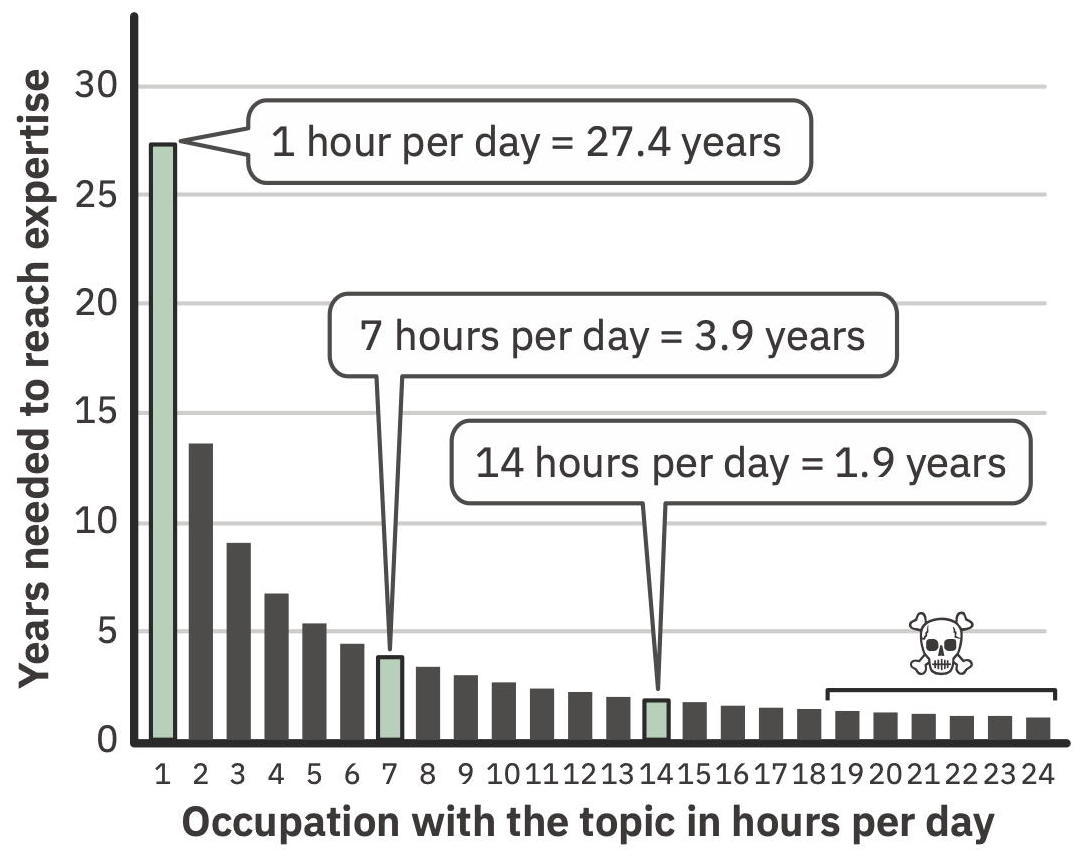
Figure 6: What approximately 10,000 hours to reach expertise means in required years of learning depending on the number of hours invested per day.
As the available time is usually scarce, increasing usable time directly increases what a person can do creatively. Few people, however, are able to spend seven hours or more on creative work, unless that is also their profession, e.g., studying professionally or working in the domain. So the issue is not only having time, but seeing it clearly and protecting the time we have.
- Accurate Time Assessment: Most people are worse than they think at estimating where their time goes. Activities are remembered in distorted ways depending on how pleasant, aversive, or absorbing they are. Tracking actual time use for a while is therefore often more useful than trying to reason about it abstractly.
- Making Time: Time can be freed by removing drains, preventing sinks, and collapsing or delegating low-value tasks. Social media, computer games, and other absorbing activities often consume far more time than expected. Likewise, automating recurring tasks, combining compatible activities,12 or limiting enjoyable but expansive tasks through time-boxing13 can create room for serious work.
- Day Structure: Creative work is especially vulnerable to low energy and reduced concentration. For many people, this means that the first usable hours of the day are disproportionately valuable. Work that requires focus should therefore be placed where energy is highest, with less demanding tasks moved later. Night owls are a special case, but even there the appeal of the night may stem less from circadian rhythm than from the conditions it creates — quiet, low interruption, reduced visibility, lower stimulation. Those conditions can often be recreated deliberately.14
- Fallow Time, Breaks, and Break Days: Defended time is not only time for effort. It also includes time that is deliberately left unassigned. Ideas, mental consolidation, recovery, and shifts in perspective often require idle cycles rather than directed effort. Such time is easily dismissed as frivolous because it does not look productive. But without it, both insight and long-range adaptability deteriorate.
Breaks and break days are equally necessary. Working past recovery may feel productive in the moment, but usually reduces capability over the following hours or days.15 Rest is not a reward for having worked — it is maintenance of the capacity to work. The same applies to breaks — they work better when you actually step away from the workplace.16
This also means distinguishing genuine rest from disguised avoidance. Fallow time is not procrastination, and recovery is not the same as flooding yourself with external input. Social media, videos, podcasts, and similar stimuli do not provide the same kind of mental recovery as unpaced idle time.17 Walks, baths, showers, naps, meditation, yoga, solitude, or simply drinking tea without additional input are often far more restorative and might lead to new insights and inspirations.18
Productivity that works over decades therefore requires more than efficient scheduling. It requires defended time for work, defended time for recovery, and defended time for nothing in particular. Without that, short-term throughput may rise for a while, but insight, adaptability, and long-term creative capacity decline.
Building Capabilities
It makes little sense to increase capabilities in the abstract. Before investing heavily in new ones, diagnose the actual bottleneck. Then choose the most viable route — learn, reduce scope, delegate, collaborate, redesign the environment, or extend capability through tools. Learning is powerful, but it is also slow. Often the better question is not «What should I master next?» but «What is the most viable way to remove this constraint?»
- Learning Deliberately: Acquiring knowledge and skill increases independence, expands the design and solution space,19 and improves judgment. It also means that you can contribute something real to collaborative work. But learning only pays if it is done deliberately. Reality-based feedback is needed — through direct application, deliberate practice,20 correction, and good teaching.21 Because learning things incorrectly is costly and hard to undo, it pays to take responsibility for one’s own learning22 and to seek the best material, teachers,23 and mentors available.
- Useful Learning: Not all learning has the same value. Some knowledge decays quickly — some remains useful for decades. Transferable capabilities are especially valuable — communication, scientific thinking,24 numeracy,25 psychology,26 and other skill combinations that remain useful across domains. A distinctive capability stack27 is often more valuable than trying to become the best at one isolated thing.
- Delegation, Collaboration, and Tools: Capabilities do not always need to be built internally. They can also be extended through collaboration, delegation, and tools. Working with other people is one of the fastest ways to increase capability, but it requires compatibility, communication,28 and judgment, as well as the ability to get one’s ideas across.29 These skills can themselves be developed.30 Some capabilities can also be externalized into tools, notes, and systems, including AI (see Tools on page 89). The goal is not to know everything yourself, but to be able to produce good work reliably.
- Meta-Capability: A crucial meta-capability is understanding one’s own behavior without drifting into rumination, sterile abstraction, or mere activity for its own sake. Behavior-based trials and reflection across multiple trials show what actually works for your creative work (see ▯ Integration Worksheet).
Underflow, Optimal Flow, and Overflow
If you notice that capabilities are constraining a specific project through underflow or overflow (see Table 9), you can intervene through the person, the environment, or the work itself — for example by changing the project, reducing its scope, or delegating parts of it.
| Aspect | Underflow | Optimal Flow | Overflow |
|---|---|---|---|
| Physical and Mental Health | low energy, poor sleep, deteriorating focus, fragile mood, reduced capacity | health is sufficiently protected to sustain work over time | overcontrol, health obsession, self-monitoring replaces work |
| Focused Work and Follow-Through | shallow effort, weak concentration, procrastination, little real progress | regular deep work, clear start points, sustained progress | overwork, all-nighters, grinding past recovery, effort detached from priorities |
| Defended Time, Recovery, and Fallow Time | too little defended time, no real breaks, no idle cycles | enough protected time for work, enough recovery and fallow time for insight | overplanned days, no spontaneity, no recuperation, every gap filled |
| Learning and Skill Acquisition | weak fundamentals, reluctance to learn, capabilities lag behind aims | deliberate learning aligned with current creative demands | endless learning, collecting knowledge without application, capability building becomes avoidance |
| Communication and Collaboration | poor externalization, weak feedback loops, inability to work with others | clear communication, useful feedback, productive cooperation when needed | communication displaces making, social process replaces creative output |
Table 9: Capabilities — underflow, optimal flow, and overflow.
As with the other elements, small changes followed by observation usually lead to better and more stable results. Over time, this allows you both to discover and to shape the conditions under which you can do creative work well.
Where it fits into your current creative process:
- Update your ▯ Creative System Map.
- Mark whether it constrains output, i.e., is a potential candidate for an ▯ Integration Worksheet trial.
Endnotes
- Going back to Lewin’s equation of B = f(P, S), behavior is a function of person and situation, capabilities here as possible behaviors limited by person and situation. ↩
- I once heard it put like this: «Would you accept it if your friends spoke to you the way your mind talks to you?» ↩
- Creative work — in the right niche — should provide more positive than negative emotions over time, allow work in accordance with strengths and talents, and should be for something larger than oneself — e.g., discovery, beauty, even making the world better for selected others. Seligman’s work on positive psychology, especially the Pleasant, Engaged, and Meaningful Life is interesting here. That creativity is hard is a plus, as easy things do not make us happy, though they are often sold this way (e.g., easy entertainment or fast food). ↩
- In some professions, other people profit by burning out a creative person quickly via short-term bursts, e.g., in music. While there is something to be said for «striking the iron while it’s hot», it can also break the person unless there is deliberate pacing. ↩
- «Xenocide» by Orson Scott Card. ↩
- Unfortunately, the idea that one «only» needs to have a creative idea to be successful does not survive contact with reality. ↩
- See «Deep Work» by Newport (2016). ↩
- See Alley (1996). ↩
- A tip from AsianEfficiency — Pham (2011). ↩
- There are countless other tips on motivation or procrastination, though frequently aligned with external reward-driven approaches (e.g., streaks). See also supplemental materials. ↩
- Chase & Simon (1973). While it might seem strange to use chess as example, it has the advantage of being easily measured and being applicable to other domains. It is also a rather conservative approximation, considering that learning chess does not require that much infrastructure and is rather easy to learn and train. For example, you can train with chess computers and there is immediate and clear feedback (checkmate or draw). Given that a typical PhD thesis that makes you an expert in a particular (sub-)domain takes about 3-4 years of full-time work, the numbers make sense. ↩
- For example, using treadmill time for reading or other low-priority input, unless that time is reserved for idle cycles. ↩
- Concept via Nir Eyal. ↩
- For example, by using earplugs or noise cancelling headphones, working behind a locked door with no phone or internet connection, and lowering the light. Recreating a night-architecture allows you to use the first hours of the day for creative work as if it were nighttime. ↩
- It makes complete sense to think that you can push through burnout. Until you are in it. Then it feels like having run way past exertion, and even though everything screams to take another step, neither your lungs nor your legs cooperate. Best to avoid that situation. ↩
- An actual break means stepping away from the place of work, e.g., the computer, and doing something different, e.g., walking to the kitchen and making a cup of tea. ↩
- Spending the time online does not count — the mind cannot relax and come up with ideas on its own when confronted with stimuli that were designed to be attractive. Much of what is found online is fast food for the brain. ↩
- To go with that Zen Proverb: «When drinking tea — just drink tea». ↩
- Awe amplifies with knowledge. Knowing what is involved in something allows you to see the world in more detail, with more of the relevant variables. For example, a sunset is beautiful, but understanding what is involved in that experience … that is something else. Or just read a new article about a topic you are an expert in. Your knowledge allows you to notice a lot of things the article glossed over (see also Gell-Mann Amnesia effect). ↩
- Deliberate practice requires appropriate difficulty (not too easy/too hard), informative performance feedback, adequate chances to repeat the task, and the opportunity to correct errors. See, e.g., Ericsson, Krampe, and Tesch-Romer (1993) and Ericsson and Lehmann (1996). ↩
- Especially for interrelated knowledge and complex skills that are hard to learn on one’s own. A typical example is scientific work that needs rigor and correction. ↩
- Unfortunately, formal education is a bit like industrially processed food — it must scale well, not be good. Often it is a watered-down or irrelevant curriculum with authority, compliance, and conformity undertones. Worse, as it needs to scale, it also goes for forms that are easily testable at scale (e.g., rote learning or memorization, some transfer questions often constrained for easy grading). While you need to know the fundamentals, the result is that actually understanding the subject, its boundaries, the conditions when something works and when it does not, is not rewarded or even actively discouraged. However, formal education is not the only nor the best pathway to learning. There are lots of other options available that are not built for test-taking but understanding (see also the supplemental materials). ↩
- Reputation can be a heuristic, but can also be misleading. A good AI can provide better teaching than many university lecturers, and much more personalized. And even a teacher who might not have the best credentials might be superior if he gives personalized, actionable feedback. ↩
- Science is powerful precisely because it is a method, not a value system. But it can still be bent towards very different ends. Understanding this makes it easier to notice when scientific language is being used as cover for political or ideological goals. Note that science is value-neutral as well, beautifully put by Richard Dawkins: «Scientific and technological progress themselves are value-neutral. They are just very good at doing what they do. If you want to do selfish, greedy, intolerant and violent things, scientific technology will provide you with by far the most efficient way of doing so. But if you want to do good, to solve the world’s problems, to progress in the best value-laden sense, once again, there is no better means to those ends than the scientific way.» ↩
- Being good with numbers is useful in many domains, as well as to check quickly whether something is possible, e.g., scrap sheet calculations, statistics, or time-effort calculations. ↩
- The scientific discipline — empirical research on humans focusing on experience and behavior — not the pop-sci, meme-heavy, self-help variant. But given that I did study psychology and did my PhD thesis in it, I am a bit biased here. ↩
- This talent stack (Scott Adams) combines three skills you can do in the top 25%, usually one related to communication, one or two passion skills, and ideally business or public speaking. A unique capability combination that sets you apart is usually more valuable and easier to maintain than being the best in a single domain or skill. Scott Adams exemplified this talent stack (cartoonist, business, public speaking), though there are other examples as well. Especially artists can combine domains and achieve work that is greater than the sum of its parts. For example, Tim Minchin’s combination of music and comedy, or writers who combined their knowledge of crime with fiction writing. ↩
- Patrick Winston nailed it with: «Your success in life will be determined largely by your ability to speak, your ability to write, and the quality of your ideas. In that order.» ↩
- For example, the capability to externalize ideas, e.g., by doing sketches or writing effective texts. The sketches just need to communicate the idea clearly and do not have to be beautiful. On the contrary, ugly but understandable sketches lower the barrier for useful feedback. Writing itself should be precise, clear, familiar, fluid, forthright, and concise to be effective (Alley, 1996). ↩
- This does not require you to be an extroverted socializer — there are other ways to be an effective communicator. For introverts, however, communication likely remains an extreme sport. ↩
Supplemental Materials
OC3 Navi
- Home | Front Matter
- Why Organize Creativity
- Creativity as a System: 1. Creativity, 2. Creative System, 3. Application, Meta: Supplemental Materials
- Framework: Foundation: 4. Person, 5. Environment, 6. Capabilities, Meta: Tools
- Framework: Ideas: 7. Generating Ideas, 8. Capturing Ideas, 9. Collecting Ideas
- Framework: Creative Focus: 10. Creative Direction, 11. Creative Energy, 12. Creative Commitment
- Framework: Projects: 13. Project Realization, 14. Project Evaluation, 15. Project Release
- Back Matter: Afterword by the Author, Afterword by AI, Sources and Foundations, References, About the Author, Feedback and Saying Thanks, Glossary, Appendix