«People think focus means saying yes to the thing you’ve got to focus on. But that’s not what it means at all. It means saying no to the hundred other good ideas that there are. You have to pick carefully.»
Steve Jobs
Time, attention, decision capacity, and implementation energy are limited. That makes the allocation of creative energy across projects a crucial issue.
A frequent problem in creative work is that energy gets spread over too many projects. This happens when idea pressure is high, e.g., because many interesting ideas are generated, or when the pressure to finish individual projects is low, e.g., no external deadlines and low commitment. Many projects are started because many ideas seem worthwhile.
This situation can feel comforting. Creativity is inherently risky — you can make success more likely, but never guarantee it. So you are not putting all your eggs in one basket. It also becomes easy to shift attention whenever a project becomes difficult («the grass is greener on the other side»).
However, if too many projects compete for attention, creative energy is diffused so strongly that little progress is made anywhere. Frequent switching fragments focus even further. Without a clear project hierarchy, overall progress stalls and the whole system starts to break down. The work may feel busy, but few if any artifacts get completed.
If too many live projects, constant switching, and implementation avoidance are issues for you, then project segmentation might be worth trying. It is not the only viable structure, but it is a powerful one when attention diffuses across too many possible projects.
Project Segmentation
Segmentation differentiates which kinds of attention and energy projects receive (see Figure 12).
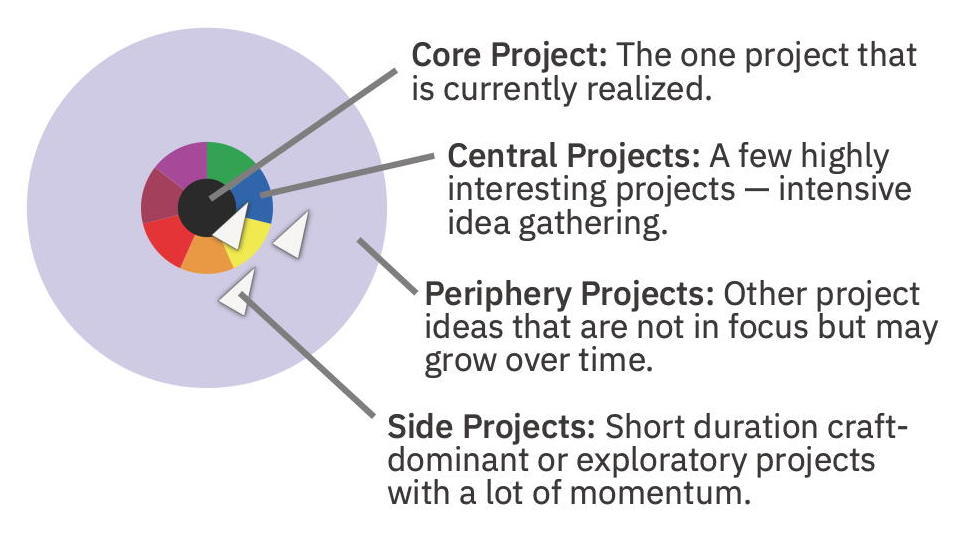
Figure 12: Project Segmentation.
It distinguishes between:
- one core project that receives the implementation energy and most of the ideation, so it is the main focus of the creative work,
- multiple central projects that receive ideation and light structuring only, so they grow over time,
- unlimited peripheral projects that hold ideas but are not actively pursued, so they do not draw attention or energy, and
- occasional highly time-limited side projects that provide quick wins and thus help maintain morale.1
A clear focus on the core project concentrates energy and allows for strong progress, which is essential for mastery and often for success — especially in domains with high competitive pressure. It does require discipline and may reduce spontaneity somewhat (see Lack of Discipline on page 173 and Repressed Spontaneity on page 174), but it increases the chance that projects are actually finished.
Core Project (Execution; one project only)
The core project is the main focus of creative energy and attention. Ideally, it is the only project that has crossed the Rubicon (see Creative Commitment on page 177) and therefore has the highest gravity with a self-reinforcing feedback loop and increasing returns.
While it is not the only project worth doing, it is the home base that currently receives implementation energy — execution, commitment, convergence, and structured problem-solving. If Wayfinding is used (see Creative Direction on page 149), the core project is the current waypoint.
In some cases, having only one implemented core project is not possible or not sensible. In work contexts, for example, there is often little choice — one may have multiple clients or multiple externally assigned projects. In some domains, doing only one project would also be inefficient, for example when feedback takes time to arrive or technical conditions impose waiting periods. In such cases, it can still help to limit focus to one project at a time for a bounded period — for example, parts of the week or day. If several projects must be active, they should usually be smaller in scope. But even then, multitasking must be avoided as it comes with high switching costs and fragmented attention.
The core project is worked on regularly and with the highest priority of all projects, usually each workday and for a meaningful amount of time, so that it can be finished as soon as possible.2 By maintaining this focus, energy returns to the same project again and again until it is either realized or aborted (kill criteria triggered, see Creative Commitment on page 177). Only then is a new core project chosen. This limits project-hopping when — not if — the core project becomes difficult.
Central Projects (Ideation; five to seven)
Central projects are promising future projects that are important enough to justify continued ideation. They live in the idea collection, have medium gravity, and receive medium attention. To avoid spreading ideation energy too thin, they should be limited to five to seven projects.
The main distinction from the core project is that central projects are not currently being implemented. Work on them is limited to ideation and light structuring, not commitment-heavy realization work. If prototyping is needed in order to test a hard problem, it should be treated as a dedicated, time-bounded side project.
Keeping several central projects at the ideation stage has a number of advantages.
- It reduces the temptation to start realizing a project immediately: With highly resonant ideas, there might be a hard-to-ignore urge: «This new idea is so cool, I must pursue it now.» However, you do not have to deny yourself the pleasure of engaging with these ideas. On the contrary, you can do so without guilt, because the ideas are allowed to grow as central projects. Only realization is postponed until the core project is finished.
- It allows you to identify and address the hard problems: During the long growth phase from initial idea to realization, you can test a proof of concept as a side project or develop approaches to the difficult parts.3 Thus, the project benefits from not having to be realized immediately.
- Restorative Breaks from Implementation: Implementing the core project often requires concentration, becomes emotionally demanding when things do not work, and can lead to decision fatigue. Ideation in central projects — and nothing beyond that — can be refreshing and restorative as the cognitive demands are different.
- Avoiding the Sunk Cost Fallacy: Having several central projects weakens the «I have already invested so much in this, so I should realize it» pressure. After all, implementation has not started yet — they have only been explored.
- Avoiding the post-project void: A lot of structure breaks away when a core project is finished. That can be aversive — up to existential despair («What now?»). With central projects, you have several options in the pipeline and can just choose the next project.
Central projects can exist in different degrees of readiness. Some may already be fairly developed, others may still contain major unresolved issues. Their level of seriousness can vary as well — some are provisional, some serious, some playful.
To keep central projects alive, a short description is useful — for example, a brief «why it matters» paragraph — plus a lightweight structure that stimulates further idea generation. For example, sections for characters, plot, setting, and so on for a fiction story.
Peripheral Projects (Possibility; unlimited)
Peripheral projects have low gravity, receive no active attention, and involve little if any work. They are just ideas, or barely more than that — speculative seeds for possible future projects.
They often result from free ideation or from noticing a problem. Since suppressing free ideation would kill it, but turning every idea into a project that demands attention would diffuse energy too much, peripheral projects simply ensure that ideas remain available for the future. They stay in the background so they do not compete with central projects.
Therefore, they have to stay small — perhaps just a title, a short summary, and a few fragments. No planning, no structure, no development, because otherwise they begin to mutate into central projects and too many central projects diffuse attention and energy too much.
As promoting or demoting a project changes the flow of creative energy, turning a peripheral project into the central project, or vice versa, should be a deliberate decision.
Side Projects (Very Quick; max. one to two days)
A core project can take months or even years, central projects grow only as ideas without being implemented, and peripheral projects just hold captured ideas. This means creative work can become demotivating when there is nothing «real» to show for — no finished pieces, no releases, and no visible wins.
In such cases, highly time- and scope-bounded side projects can be a lifeline.
The focus here is on craft-dominant or exploratory projects with a lot of momentum. They are small in scope, have little mass and high bursts of energy, so they can be realized quickly, often on break days, without interfering with the core project.
That requires that few if any decisions are needed. The hard problems are already solved or the main focus of the side project, e.g., doing a proof of concept or solving the hard problem as explicit goal.
These side projects are not slow-growing central projects, but small implementable ones. They must be strongly time-bounded, otherwise they sprawl easily (see Side Projects Break Out on page 174). If they cannot be finished within that period, or begin to interfere with the core project, they should be aborted and/or returned to the collection.
If Wayfinding is used, side projects also preserve exploration, flexibility, curiosity, and play while the broader aspiration remains intact. Creative work can be serious, and there is much to be said for highly focused, highly conscientious work. But without play and exploration, improvement often becomes merely incremental rather than transformative.
For example, even if your aspiration is to write mystery novels, it can still be rewarding to explore other forms of writing, or even other media. Provisional, playful, and with no concern about whether they move you closer to the larger aspiration. Simply exploring something interesting. Sometimes such experiments lead to important later projects. And if not, that is fine too.
Doing Project Segmentation
Project segmentation depends on the idea collection (see Col-lecting Ideas on page 129), which functions in part like an enhanced someday list. It reduces the pressure to realize all ideas at once, because ideas and projects that are not currently being realized are stored in it and cannot be lost.
Segmentation requires a deliberate decision about the core project (see Creative Commitment on page 177) and the selection of five to seven central projects. If no project is currently ready to be realized, then only central projects exist and continue to grow until one is chosen as core project.
The core project always comes first, with deep-work phases each workday. Because realizing a project requires many decisions, and decisions are cognitively tiring, breaks during the day are necessary. Full break days are necessary as well for longer projects. Otherwise the core project itself becomes aversive and after a while, you just «can’t stand the project anymore». During these breaks, moving into the ideation phase of central projects can be both relaxing and energizing.
Because central projects are not being implemented, they require fewer decisions and therefore do not interfere much with progress on the core project. Switching between these different cognitive-load profiles can help maintain long-term momentum without burnout. It should also help prevent abandoning a temporarily tedious or difficult core project simply because another project still allows for exciting idea generation. Instead, you take a break, then return to the core project and work on the issue. If a quick win is needed, a short side project can be done on a break day or two.
However, because playing with an exciting project can be far more fun than working through a tedious phase of the core project, discipline is still needed. Otherwise central or side projects can displace the core project at exactly the wrong moment. The core project therefore has to come first — for example, by doing the deep-work phases before exploring central or side projects.4 If ideas for other projects occur during that time, just capture them quickly. Afterwards, they are not explored further but the work returns to the core project.
Project positions can change over time. A peripheral project can become a central project, but this usually means that a central project has to be demoted. Sometimes a project simply no longer feels interesting, or its moment has passed. Often ideas that initially seemed brilliant fade after the first enthusiasm disappears, while other ideas are generated and fleshed out. The core project, however, should remain fixed until it is either realized or the kill criteria are triggered. A hard or tedious phase is not sufficient reason to abandon it.
This segmentation approach is especially useful for people who need novelty, have low inhibition, and have difficulty sustaining implementation. The core project advances every workday, while central and peripheral projects still provide novelty when the core project becomes boring, without derailing execution. Idea bursts are captured and added to the collection. You can still play with wild ideas, just not realize them yet.
In practice, a person might work on a non-fiction book that requires attention over many months, for example, one or two deep-work phases each workday. At the same time, other project ideas provide space for play — fiction ideas, research ideas, sewing ideas. But they remain at the ideation and structuring stage, and this exploration happens mostly during breaks. Other ideas accumulate as peripheral projects. One or two may become central projects, while stale central projects are demoted. A few side projects are realized as well, for example, sewing a pen case, writing an RPG scenario, or a guide to a Constraint Planner. Because the focus remains on the core project throughout, it progresses and gets finished.5
Common Failure Modes of Creative Energy
Common failure modes here are diffused energy, lack of discipline, mixing segments, side projects breaking out, and repressed spontaneity.
Diffused Energy
If energy is spread over too many projects, progress stalls. The attempt to do everything results in not doing very much at all.
It does not have to be the exact segmentation model proposed here, but some way of focusing energy is needed.
Lack of Discipline
It can be difficult to keep the segments intact, especially if you are used to more spontaneous project work. However, this does not have to rely on sheer discipline alone. Segmentation can be made easier by structuring the environment so that the core project stays in focus and central and peripheral projects stay in their place. For example, the core project can be made more salient in the workspace, while central projects get dedicated sections in the idea collection and peripheral projects are kept in a less salient area.
Mixing Segments
It is often tempting to work on central projects as if they were lesser core projects, or to expand peripheral projects into central ones without noticing. But that destroys the main advantage of the system that the core project comes first.
If central projects are treated like secondary core projects, they compete not only for time but also for decisions. Even when the time is available, the energy needed to make good decisions degrades quickly, and both the core project and the central ones suffer. If peripheral projects are treated like central projects and actively expanded, energy is diffused over too many fronts.
Thus, keep the segments clean.
Side Projects Break Out
Side projects allow you to experience the joy and self-efficacy of finishing things even while the core project takes weeks, months, or years.
But side projects can easily break out. Instead of taking a day or two, they suddenly take weeks. Whether because a hard problem was overlooked or because they are simply more fun, they begin to interfere with the core project.
That is why they need hard constraints with kill criteria.
Repressed Spontaneity
Adhering to the segments can also reduce spontaneity, sometimes too much. If every creative impulse that does not fit neatly into the scheme is denied, the system starts doing damage.
While focus on the core project is necessary for finishing it, especially with complex work, there must still be room for play and exploration. Side projects allow this, provided they remain bounded and do not interfere with the core project.
Done well, you get the freedom to explore interesting things while the core project still progresses.
Underflow, Optimal Flow, and Overflow
Flow problems in creative energy often involve either too few or too many active projects (see Table 16).
| Aspect | Underflow | Optimal Flow | Overflow |
|---|---|---|---|
| Core Projects | not deciding on one; starting and quitting quickly when work becomes hard or tedious; no force behind projects | clear focus on one core project that always comes first | starting many projects and trying to pursue them equally despite energy spreading thin |
| Central Projects | having none or too few; risk of falling into a hole when the core project is done | keeping a handful of central projects growing without implementing them | having too many; trying to implement them so they compete with the core project |
| Peripheral Projects | having none, so no growth while working on other projects | large collection with deliberate movement into central projects when warranted | making them too salient so they act like central projects and drain attention |
| Side Projects | doing none, resulting in long phases without finishing anything | occasional side projects for exploration and quick wins | side projects gain too much mass and displace the core project |
Table 16: Creative Energy — underflow, optimal flow, and overflow.
It matters how your creative energy is currently focused. If the present balance of your projects diffuses energy too much, then segmentation might help.
Where it fits into your current creative process:
- Update your ▯ Creative System Map.
- Which projects are you currently working on? How much energy and attention do they receive? Is there a deliberate core project, central projects, and peripheral projects? If you work on a single long project, do you make room for side projects?
- Mark whether it constrains output, i.e., is a potential candidate for an ▯ Integration Worksheet trial.
Endnotes
- Deliberately not included here are archived ideas and projects, e.g., finished projects or ideas moved into cold storage. Because they are not in the active part of the idea collection — not included in searches and the like — they do not compete for attention and energy. ↩
- This requires a long-term view of creative productivity, which includes adhering to breaks and break days. ↩
- However, some hard but solvable problems require the determination that comes from starting without knowing whether they can be solved («I didn’t know it was impossible when I did it.»). It is akin to jumping into a pit to see whether you can get out again. However, the risk of failure and wasted resources is high — you might bury yourself alive. ↩
- This is a serious problem and can torpedo progress on the core project. On the plus side, even if side projects have to be reined in at times, some nice work can still be created while working on a core project for a long time. ↩
- You are currently reading it. ↩
Supplemental Materials
OC3 Navi
- Home | Front Matter
- Why Organize Creativity
- Creativity as a System: 1. Creativity, 2. Creative System, 3. Application, Meta: Supplemental Materials
- Framework: Foundation: 4. Person, 5. Environment, 6. Capabilities, Meta: Tools
- Framework: Ideas: 7. Generating Ideas, 8. Capturing Ideas, 9. Collecting Ideas
- Framework: Creative Focus: 10. Creative Direction, 11. Creative Energy, 12. Creative Commitment
- Framework: Projects: 13. Project Realization, 14. Project Evaluation, 15. Project Release
- Back Matter: Afterword by the Author, Afterword by AI, Sources and Foundations, References, About the Author, Feedback and Saying Thanks, Glossary, Appendix