«The great composer does not set to work because he is inspired, but becomes inspired because he is working. Beethoven, Wagner, Bach and Mozart settled down day after day to the job in hand with as much regularity as an accountant settles down each day to his figures. They didn’t waste time waiting for inspiration.»
Ernest Newman
Where do ideas come from? Some people have them while walking, others in the shower. Some need peace and quiet so imagination can run free. Some need hard constraints or the material in front of them to reveal gaps and possibilities. Others generate ideas in interaction with other people or by reaching into emotion.
Whatever the source, it helps to look at idea generation in context — what ideas need in order to arise, and how they improve.
A cyclic model of ideation1 (see Figure 7) distinguishes five recurring phases — occupation with the subject, incubation, insight, evaluation, and elaboration.
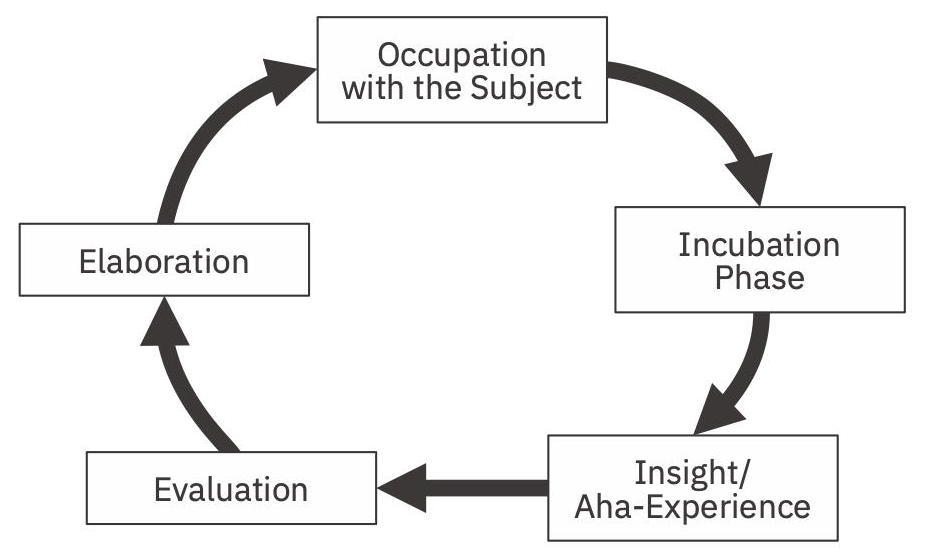
Figure 7: Cyclic Model of Ideation based on Wallas (1926; see also Csikszentmihalyi, 1996)
Each pass through the cycle can move the work one step further, after which the cycle begins again. In practice, these stages can overlap, loop, or occur in parallel.
The model highlights three basic facts about ideation — first, it requires knowledge and time, second, inspiration and insight cannot be forced, and third, ideas improve through repeated cycles of evaluation and elaboration.
Thus, ideation is not a matter of luck or inspiration alone. It can be designed for.
Preconditions for Ideation
The following conditions strongly influence how many ideas are generated and how good they are.
Knowledge for Ideas
Occupation with the subject is a precondition for generating ideas — or rather, for generating ideas that actually work. This usually benefits from a good analysis (see Understanding a Situation on page 221) so that the situation is fully grokked.2
Without enough understanding of the domain, idea generation is easy and coherent. Constraints, requirements, and exceptions are not yet known, so there are few inner contradictions and little early filtering of unworkable ideas. That makes ideation feel easy and fun — until the beautiful ideas shatter on contact with reality.3
The opposite problem also exists. Too much domain knowledge can impede ideation just as effectively — especially knowledge of what supposedly cannot be done. Ideas are discarded too quickly because the mind generates reasons why they will fail rather than ways in which they might be made to work. In effect, squelchers and killer phrases4 become automatic thoughts.
So what is needed is balance — enough knowledge to understand the domain, but enough openness to keep asking how something might be made to work.
Unassigned Attention
Unbounded ideation, problem-finding, and Open Creative Ideation (see Ideation Types by Project Stage on page 99) require unstructured attention. The mind has to be left free to wander, e.g., no music, no podcasts, and no screens. Such periods support not only ideation, but also incubation, consolidation, recombination, recalibration, and long-horizon thinking.
In the short term, however, these states often feel aversive or wasteful. So most people pre-allocate their attention automatically. They fill idle moments to escape boredom, restlessness, low arousal, or the darker places a wandering mind might enter. That removes short-term discomfort, but it also removes powerful sources of ideas (see also Interruptions and Distractions on page 66).
Thus, such time has to be actively protected. Walking, bathing, showering, lying in bed before sleep or after waking, repetitive exercise, or eating alone can all serve this function — but only if they are left uninterrupted. The point is to stop interfering with the conditions under which ideas tend to arise.
More focused forms of ideation can also be supported by Creativity Methods and Techniques (see page 105). Their value often lies less in what they directly produce than in creating legitimate time to pause, explore, and think.
Protection from Overcontrol
Inspiration and insight are highly valued in creative work and need to be protected from overcontrol.
Inspiration is related to intensity, coherence, and the quality of work. Without it, the upper limit is often competent work. But because it is not under voluntary control, it cannot serve as a criterion for action. Deliberately waiting for inspiration often only ensures that nothing is created.
Insight, especially in problem solving, also depends on breaks with idle time. Sustained conscious effort narrows the search space, but insight solutions often lie outside that cone. A break reduces fixation on previous wrong attempts and allows the search to reopen. One reason insight problems are hard is that they provide almost no feedback — until the last step, you often do not know how close you are to a solution.5
Both are second-order phenomena — they depend on weak signals, latency, and emergent coherence. The more directly they are watched, forced, or expected, the less likely they become.
What they need is prior occupation with the subject, followed by conditions in which the mind is left alone long enough to reorganize. Expectation interferes. Thinking «I am walking without distraction, so the solution should come now» makes insight less likely, not more.
It therefore works better to make such conditions where the mind is left alone ordinary rather than special. Regularly walk part of the way to work. Leave some transitions unfilled. Let idle cycles occur often enough that they are no longer burdened by expectation.
This cannot guarantee inspiration or insight, but it can make both more likely. See also the ▯ Integration Worksheet examples 5 and 6 for a bad and a good trial.
Ideation Types by Project Stage
Ideation can take different forms and produce different kinds of ideas. To be useful, it has to fit the stage of the project.
At first, ideation is usually unbounded — free ideation and problem-finding. Once a project is chosen, ideation becomes more focused — divergent exploration, creative problem solving, and later classical problem solving.
Thus, as the project becomes more defined, ideation usually becomes more structured, deliberate, feasibility-bound, evaluative, and often more collaborative. This shift also changes which Creative Engines (see page 101) and ideation modes are most useful.
- Free Ideation (unbounded, e.g., «Where did that come from?»): Ideas that simply appear during idle times — walking, showering, incubation, relaxed drift. They are intuitive, unconstrained, opportunistic, personal, and often unconscious. Still, they are never uncaused. They are shaped by prior knowledge, experience, and stimulation. Discovery modes provide much of this raw material.
- Problem-Finding (opportunity discovery, e.g., «What do people need?»): Sensing a gap, tension, need, or possibility. Often the task is not yet to solve a problem, but to identify the right problem. That is harder than it sounds, because people often know only what they want, not what they actually need.6 The result can be solving the wrong problem or settling for incremental improvement where something more fundamental is possible. Associative Drift (spotting weak signals), Serendipitous Collision, Emotional-Motivational Ignition (sensing tension), and Interpersonal Synchrony Ideation (sensing needs) fit here. Constraint-Driven Exploration does not — it responds to defined problems, it does not discover them.
Once the project is more defined, focused ideation becomes more important:
- Divergent Exploration (open creative ideation, e.g., «What could this become?»): Generating many possibilities around a particular project without worrying too early about constraints. This is useful when shaping a concept or exploring directions. Associative Drift, Internal Simulation, Interpersonal Synchrony Ideation, Externalization (sketching branches), and sometimes Kinesthetic-Embodied Ideation fit well here. Common failure modes are premature filtering, stopping too early, and rule-bound thinking.
- Creative Problem-Solving (constrained creativity, e.g., «What is feasible inside the real limits?»): Used when the concept is defined and a workable solution is needed. The aim is to make the idea real — for example by building the first prototype. This usually moves the work toward engineering or craftsmanship. Domain and field affordances matter strongly here (see Ignoring the Domain and Field Aordances on page 109), the focus has to be on the hard problems (see Working on the Wrong Problem on page 106), and goal conflicts often appear. Structure modes are especially useful — discovery and state modes are usually too diffuse unless they feed the process indirectly.
- Classical Problem-Solving (implementation fixing, e.g., «How do I solve this?»): Ideas needed during mid- to late-stage work — fixing bugs, solving scene problems, improving performance, or repairing breakdowns. Here the goal and rules are often clearer, so the solution space can be decomposed into subproblems. Structure modes dominate, especially Internal Simulation and Externalization.
Creative Engines
Ideas can be generated by at least three creative engines — discovery, which provides raw material, structure, which shapes it, and state, which shifts the system so new material becomes possible.7
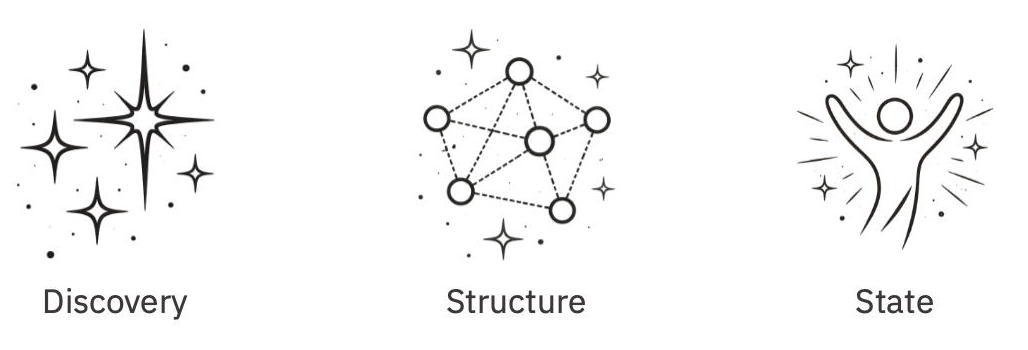
People differ in which engine they naturally begin with, but most projects move through several engines and modes. This often happens unconsciously — an idea appears through drift (discovery), then gets externalized, refined, constrained, and tested (structure). But engines and modes can also be shifted deliberately when the current one stalls.
Whether a mode works depends on the individual, the domain and field (see Ignoring the Domain and Field Aor-dances on page 109), and the stage of the project (see Ideation Types by Project Stage on page 99).
See also the supplemental materials for more information on the engines, modes, and associated creativity techniques and methods.
Discovery (provides raw material)
Discovery works through associative emergence — fast, unbidden, intuitive, emotional, and sensory. Ideas appear when the mind makes surprising connections through drift, serendipity, memory, or emotional flashes. This engine is highly state-sensitive — anxiety tends to collapse it, playfulness expands it, anger sharpens it, sadness can slow it down but deepen it.
Its starting point is the spark — ideas that simply arrive while walking, showering, relaxing, or drifting. Discovery thrives on fragments, glimpses, and intuition. Pushing harder usually does not help — loosening does.
It fits domains that depend on surprise, novelty, and emergence, such as fiction writing or early-stage startup ideation. Structure comes later.
Modes are:
- Associative Drift (AD): Ideas from loose, spontaneous wandering. Best for ill-defined questions, fresh angles, or situations where analytic pushing has stalled. Enter it by lowering cognitive pressure and allowing relaxed alertness. For example, through gentle idleness (walk, shower), reduced sensory demands, blocking «non-doing phases», and preventing interruptions.
- Serendipitous Collision (SC): Ideas from unexpected contact between unrelated materials. A felt «click» signals relevance. Best for conceptual innovation, metaphorical insight, and unexpected recombination. Enter it through broad exposure, analogy, field-jumping, and mixed input. For example, through browsing, wandering, mixing domains, using analogies and mashups, broad reading, or visiting stimulating environments (e.g., libraries).
- Inner Retrieval (IR): Ideas drawn from memory, identity, emotion, or personal history. Best for value-laden, emotionally stuck, or autobiographical material. Enter it through quiet, inward-facing conditions and reflective prompts such as «What does this remind me of?» or «Where have I felt this before?»
Structure (shapes the material)
Structure works through deliberate recombination and simulation — slow, methodical, analytical, and reflective. Ideas emerge when a problem is defined, organized, and deliberately explored.
Its starting point is existing material. The work is to shape, formalize, simulate, refine, reframe, and recombine it into something usable. Structure thrives on visible organization, questions, and constraints. Progress comes from method — e.g., lists, graphs, tables — rather than surprise.
It fits domains that require coherence, rigor, or precision, such as engineering, scientific research, and programming.
Modes are:
- Internal Simulation (IS): Mental rehearsal, imagery, and model-based inner testing. It can involve any sense — visual imagery, imagined taste, texture, or aroma in cooking, or sound in music. It also includes mental models, for example how a machine, process, or experiment will run, or how users will behave. Best for sequencing, systems thinking, and coherence problems. Enter it through a quiet environment, especially one that protects the relevant sense, and then start imagining it.
- Externalization (EX): Sketching, outlining, writing, diagramming, or prototyping. Best for messy, multivariable, or material-dependent problems, and anything that needs to be explored through doing. Enter it by working with the material, e.g., via sketching, prototyping, or drafting.
- Constraint-Driven Exploration (CD): Working by imposing tight limits, rules, or boundaries. Best for overly open problems, or tasks requiring precision or efficiency. Enter it by identifying the relevant constraints or setting tight limits — for example regarding time, rules, or number of elements.
- Deliberate Combinatorial Search (DCS): Systematic recombination of variables and options. Best for redesigns, variants, structured exploration, and option spaces. Enter it by defining the relevant constraints, breaking the problem down, mapping the variables, and recombining them systematically.
- Representational Shift (RS): Reframing the problem by changing metaphor, perspective, scale, or assumptions. Best for dead ends, hidden assumptions, and wrong-question problems. Enter it by writing down the current framing and asking questions such as: «What if the opposite is true?», «What is the real problem?», or «Which assumptions depend on something else that we might change?»
State (shifts the system)
State works through affect, embodiment, and interpersonal attunement. Here, ideas depend on entering a state in which new material becomes available.
Its starting point is a shift — emotional, physical, or social. Ideas emerge through movement, resonance, urgency, emotional charge, or co-regulation with another person. In this engine, novelty becomes available because the system itself changes.
It fits domains grounded in embodiment, performance, or affective immediacy, such as improv, dance, acting, and some collaborative design work.
Modes are:
- Emotional-Motivational Ignition (EMI): Ideas driven by frustration, longing, urgency, obsession, or personal meaning. Best for problems needing narrative force, meaning, or direction, personal projects, or work requiring passion. Enter it by reconnecting with why the idea matters — through personal stakes, frustration, longing, values alignment, urgency, or meaningful obstacles.
- Kinesthetic-Embodied Ideation (KEI): Ideas driven by movement, gesture, physical enactment, or spatial change. Best for spatial, procedural, narrative-flow, or movement-dependent problems, sequences, interactions, or anything that has to be felt. Enter it through walking, gesturing, acting it out, or moving materials around.
- Interpersonal Synchrony Ideation (ISI): Ideas emerging through attunement with another person — shared pace, shared attention, resonance, and microtiming alignment. The key feature is resonance — two people get into a rhythm and ideas appear between them, not inside either one alone.8 Best for multiperspective problems, complex conceptual spaces, design, choreography, improv, invention, and situations that need live state-shifting rather than solitary analysis. Enter it with a partner you trust intellectually and emotionally. Meet while standing or walking, or move lightly. Use eye contact or parallel posture. Begin with something emotionally charged or curiosity-heavy.
Creativity Methods and Techniques
There are countless creativity techniques, many of which can be understood as specializations of particular ideation modes — for example, Stimulus Safaris as a form of Serendipitous Collision or Rubber Ducking as a form of Externalization. A collection of such techniques is in the supplemental materials.
If ideation is a bottleneck, modes and techniques can be used to jump-start the process. They still require knowledge, skill, and usable information about the issue.
Because people, working styles, circumstances, and domains differ, there is no single best method. The criterion is not how «creative» or exciting a method feels, but whether it generates relevant ideas. Enjoyment matters, but it is not enough.9
AI can support ideation by expanding options, externalizing half-formed thoughts, and helping the user explore a problem space. But it also risks changing the creator’s role from maker to selector or manager. Especially early in the creative process it can massively bias what comes after it. See Tools on page 89.
In general, ideation works best when multiple modes are part of ordinary life and ideas are generated continuously, rather than being invoked only in a pinch.
Common Failure Modes of Ideation
Common ideation failures are working on the wrong problem, converging too quickly, treating ideas as special, evaluating too little, and ignoring domain and field affordances.
Working on the Wrong Problem
In creative projects, there is a strong temptation to work on the parts that are easiest to solve, because they create quick visible progress and are often more fun. This temptation grows when the hard parts turn out to be harder than expected. The result is that time, effort, and resources accumulate before it is even known whether the project can succeed.
For example, someone wants to write a book and designs the perfect cover before writing the manuscript. Or students iterate endlessly on the layout of an app without knowing whether they can build its functionality. This does not mean such work is always useless.10 It means it must remain secondary until the real bottlenecks are addressed.
Astro Teller’s metaphor of «monkeys and pedestals»11 captures this well. If the goal is to train a monkey to juggle flaming torches while standing on a pedestal in a public park, one can either train the monkey or build the pedestal. Many people build the pedestal first because it is easier. But the pedestal is worthless unless the monkey can actually be trained. So the monkey problem has to come first. If it proves impossible,12 the showstopper is discovered early, before major time, money, and identity have been invested.
So when using focused ideation to flesh out projects, attack the hard parts first — the monkey problems. Easy parts can be captured as they arise. The rest is usually «only» a matter of craft.
Converging Too Quickly on a Suboptimal Solution
A common failure mode when generating ideas is premature convergence. One idea dominates too early, for example because it initially genuinely seems like the best idea. Given that strong bias in its favor, exploration of the design space shuts down. The initial idea is improved until it reaches its best form. However, that might only be a local maximum. Other ideas, which were no longer explored, might have led to much better solutions if they had been elaborated further (see Figure 8).13
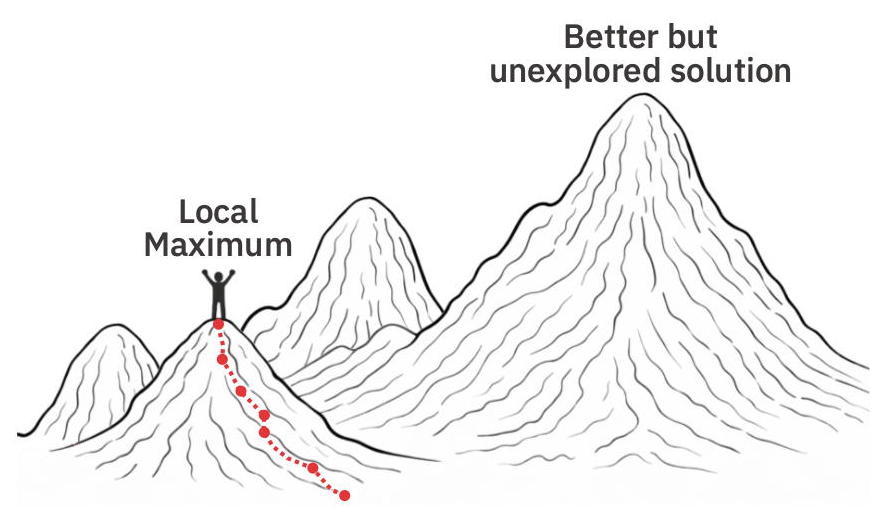
Figure 8: Premature convergence on a local maximum in the design space. A currently best-looking idea can stop further exploration even though a much better solution may still exist elsewhere in the design space. The underlying design-space concept is discussed by Greenberg, Carpendale, Marquardt, and Buxton (2012).
The path to these better ideas often runs through bad or even crazy ones. However, you cannot deliberately generate bad or crazy ideas — that would not work.14 The point is to delay judgment for a while, to entertain and follow ideas without endorsing them,15 and to use bad or unethical ones as the basis for better ideas. In some cases, they are even needed first — for example, in order to devise defenses against them (e.g., adversarial mindset, red teaming). In other cases, being comfortable with thinking or voicing bad or crazy ideas opens up remote regions of the design space.
Thus, multiple ideas should be explored in parallel to see where they lead, rather than committing too early to a single «obvious» one. This is the principle of «First get the right idea, then get the idea right».16
Seeing Ideas as Special
In the cyclic model, ideas are elaborated, reduced, recombined, and replaced. Bad ideas can become the basis of better ones. Crazy ideas can signal that censorship has not yet taken over.
But that also means that most ideas will not survive into the final work. That is normal ideation, not a failure.
For that reason, ideation has to become cheap, frequent, and ordinary. Once ideas are generated as part of ordinary life — during idle phases, during work, during structured exploration — they stop feeling precious. That makes it easier both to generate more of them and to discard them when needed.
Ideas matter because they enable the project — they are usually means, not ends.
Insufficient or Postponed Evaluation
Evaluation belongs to the ideation cycle because coherence is easy to mistake for truth. An idea can make sense internally and still fail in reality.
That is why external evaluation is needed, ideally early (see Project Evaluation on page 211). Some avoid evaluation or do it haphazardly, because they fear the idea may fail. That fear is understandable, especially when it feels like the only idea they have. But discovering failure early is still better than discovering it after large investments of time and effort.
Ideas can be replaced — wasted resources cannot.
Ignoring the Domain and Field Affordances
Creativity happens at the intersection of individual, domain, and field.17 Ideation modes therefore have to fit all three. A mismatch with the individual is usually noticed quickly. A mismatch with the domain or field often takes longer and creates unnecessary friction.
Every domain has structural affordances that shape how ideas can form, what counts as progress, and which modes work naturally. Using the difference between scientific research and improv again (from page 18), they differ, for example, in temporal flexibility (time before you must act), representational persistence (can you draft, revise, externalize), constraint level (rules and boundaries you must respect), and emotional or social density (are you alone or with others, under emotional pressure). In science, Internal Simulation, Externalization, and Constraint-Driven Exploration fit well — in improv, those same modes tank the performance. There, Emotional-Motivational Ignition, Kinesthetic-Embodied Ideation, and Interpersonal Synchrony Ideation are often much better suited — which would look insane in science.
Fields determine what is recognized, selected, legitimized, and remembered as creative. Some fields reward novelty and risk — others reward stability, usually for very good reasons (e.g., compare comedy vs. bridge engineering). In some domains, standards are largely set by the physical world. In others, aesthetics, taste, and social judgment matter more.18 In any case, ideas eventually have to be translated into forms the field can recognize. A scientist may discover like a poet — as with Kekulé’s snake dream — but must argue like a lawyer in publication. A comedian may arrive at material through internal simulation, but if the result lacks emotional immediacy, the performance will fail.
Mode mismatch can even contribute to imposter syndrome, when a mode feels natural to the person but alien to the domain or field.
The supplemental materials address these fit problems in more detail.
Underflow, Optimal Flow, and Overflow
Although creativity discourse usually focuses on generating ideas, ideation is rarely the true bottleneck in realizing projects. If the work keeps moving — through small insights, usable material, and increasing clarity — ideation is usually sufficient. Some ideation blocks also come less from a lack of ideas than from fear of feedback, doubt, or resistance to exposure (see Project Release on page 233).
Still, ideation can underflow or overflow (see Table 11).
| Aspect | Underflow | Optimal Flow | Overflow |
|---|---|---|---|
| Knowledge for Ideas | lack of domain knowledge and embodied skill leads to ideas that seem coherent but do not work | sufficient knowledge to understand the requirements and constraints, without being discouraged by them | expert status leads to seeing what cannot be done instead of finding out how it might be done |
| Unassigned Attention | attention is constantly pre-allocated, so there is no incubation and no time for more structured approaches | establishing periods without external distractions, and using creativity methods to work deliberately on project ideas | blocking too much time for ideation at the cost of craftsmanship |
| Protection from Overcontrol | no idle cycles, insufficient understanding of the problem, seeing it as miraculous and not creating the conditions for it | making idle cycles a normal part of the day and not expecting anything from them | trying to force ideation, especially inspiration and insight, and thereby preventing it |
| Ideation Types | using the wrong type for the project stage and generating unusable or confusing ideas (e.g., drift when the project needs to be finalized) | switching to the required type of ideation depending on what is needed (e.g., from finding a new project idea to solving a bug) | still generating types of ideas that are no longer needed |
| Creative Engines, Modes, and Methods | using them in an ad hoc manner | determining which engines, modes, and methods fit the stage of the project, the individual, and the domain or field | overfocusing on particular engines, modes, or methods; continuing to generate when the project needs to be finalized |
| Common Failure Modes of Ideation | wrong problem: pedestals before monkey problems; insufficient evaluation; ignoring domain and field affordances | solving the monkey problems first | premature convergence on a suboptimal idea; clinging to an idea because it seems precious |
| Table 11: Idea Generation — underflow, optimal flow, and overflow. |
Common underflows are droughts and misalignments — too little new input, too little variation, or ideas that are not connected to the actual project. Where the underlying problem is solvable, such underflows can usually be improved through more knowledge, more unassigned attention, or better-matched engines and modes (Creative Engines on page 101). Stale ideation often needs more discovery, chaotic ideation often needs more structure, and overabstract ideation may need stronger re-anchoring in material or action.
Overflow occurs when novelty floods the system without producing progress — especially when low-quality ideas overwhelm both capturing and collecting. Then noise begins to crowd out the project. In such cases, stronger quality constraints are needed. Low-effort capture can preserve surplus ideas for later, as long as capturing itself does not begin to compete with the core work.
Where it fits into your current creative process:
- Update your ▯ Creative System Map. Where do ideas actually arise in your life — in contexts, triggers, or situations, not in ideals? For example, while working, away from work (e.g., walking, commuting), during consumption (e.g., reading, listening, conversations), or unpredictably.
- What typically happens next? Do nothing, note it mentally, write it somewhere, lose it, and so on.
- Mark whether it constrains output, i.e., is a potential candidate for an ▯ Integration Worksheet trial.
Endnotes
- Based on Wallas (1926; see also Csikszentmihalyi, 1996). ↩
- grok = «to understand thoroughly and intuitively» (a term invented by Heinlein, 1989) ↩
- It depends on the person how that contact goes. Some become very adamant that their ideas work, people are just too ignorant to implement them. Others become disappointed and stop generating ideas. The issue is a simple underflow — the foundation is insufficient. Fixing the gap in knowledge would work, e.g., through learning or collaboration. After all, the desire is there, the craft is missing. ↩
- Squelchers and killer phrases are sentences that can be used to discard any idea, irrespective of the characteristics of the idea. For example, «That will never work.», «We’ve always done it that way.», «Don’t rock the boat!», «That’s not my job!» or «Too risky!». They can also occur as thoughts you have. In contrast with useful «how do I make the idea work» thoughts or objections, these squelchers make a judgment (e.g., «doesn’t work») without providing arguments or evidence. And they are not interested in making the idea work — just to stop it. ↩
- As an analogy, that is akin to walking through a labyrinth — you might get closer to the exit, but until the last turn, you don’t know that you do. That is why the insight experience is so surprising, you cannot see the solution coming until you have done it (cf. Anderson, 2013). ↩
- For example, customers might tell you they want a more efficient communication application, when what they actually need is a redesigned process that makes this communication superfluous. ↩
- Parts of the ideation section were sharpened through extended analytical dialogue with AI tools. The final structure, selection, and integration are my own. ↩
- For example, jazz improvisation, deep philosophical conversations, two co-writers who «finish each other’s sentences», paired problem solving, or lovers who share silence that feels intelligent rather than empty. Speech can be present, but it is not the generator — state alignment is — and speech enforces this state. ↩
- There is a strong bias, especially in organizations, toward group «creativity workshops» built around verbal participation and facilitation. These can be useful for externalization or constrained exploration, but they are often mistaken for ideation itself. In practice, they may produce visibility, fragments, and social alignment more reliably than genuinely strong ideas. ↩
- I designed the cover during the early writing process, but after I knew that I would be able to write the book, having written multiple books before. And I invested only a limited amount of time when I was too tired for serious writing. ↩
- Cited via Duke (2022). ↩
- For example, you might run into wicked (hard to define, resistant to resolution), anchor (prevent movement), and gravity problems (facts of life, have to build around; see Burnett & Evans, 2016). Functional fixedness, false dichotomies, and being misled by analogies are common failure modes (see the supplemental materials, esp. Creativity Methods). ↩
- Greenberg, Carpendale, Marquardt, & Buxton (2012). ↩
- If bad ideas were deliberately created, it would be clear to everyone, including yourself, that bad ideas are acceptable only as deliberately produced bad ideas. As straw men, so to speak. But that means that there is no force behind these ideas, they are not made to bear improvement, nor meant seriously. Thus, nothing good can be built upon them. In contrast, an idea that seems crazy but it might work, or seems interesting at first glance but is actually pretty bad, and that can be stated or thought without negative reaction opens up the design space to more remote regions. ↩
- Aristotle’s «It is the mark of an educated mind to be able to entertain a thought without accepting it.» applies here as well. ↩
- Greenberg, Carpendale, Marquardt, & Buxton (2012). ↩
- Csikszentmihalyi (1996). ↩
- Deanna Kuhn’s work on epistemological beliefs is interesting here — especially regarding the differentiation between the physical world, social world, values, aesthetics, and personal taste (e.g., Kuhn, Cheney, & Weinstock, 2000). ↩
Supplemental Materials
OC3 Navi
- Home | Front Matter
- Why Organize Creativity
- Creativity as a System: 1. Creativity, 2. Creative System, 3. Application, Meta: Supplemental Materials
- Framework: Foundation: 4. Person, 5. Environment, 6. Capabilities, Meta: Tools
- Framework: Ideas: 7. Generating Ideas, 8. Capturing Ideas, 9. Collecting Ideas
- Framework: Creative Focus: 10. Creative Direction, 11. Creative Energy, 12. Creative Commitment
- Framework: Projects: 13. Project Realization, 14. Project Evaluation, 15. Project Release
- Back Matter: Afterword by the Author, Afterword by AI, Sources and Foundations, References, About the Author, Feedback and Saying Thanks, Glossary, Appendix