Suddenly a horrid vision came into his mind, as his thoughts burst free from time and slid into the future, which lay quivering before him. A race taught to go for all its answers here, to the shrine which had all the right answers. A world where no question could ever be left open, for it had all the answers, and what lay outside it was not possible to explore.
A barbarian world with the computer worshipped as a God.
A God. A God. A God.
«Darkover Landfall»
In dealing with computers, I really like the distinction between wizards and sorcerers in how effects are achieved:
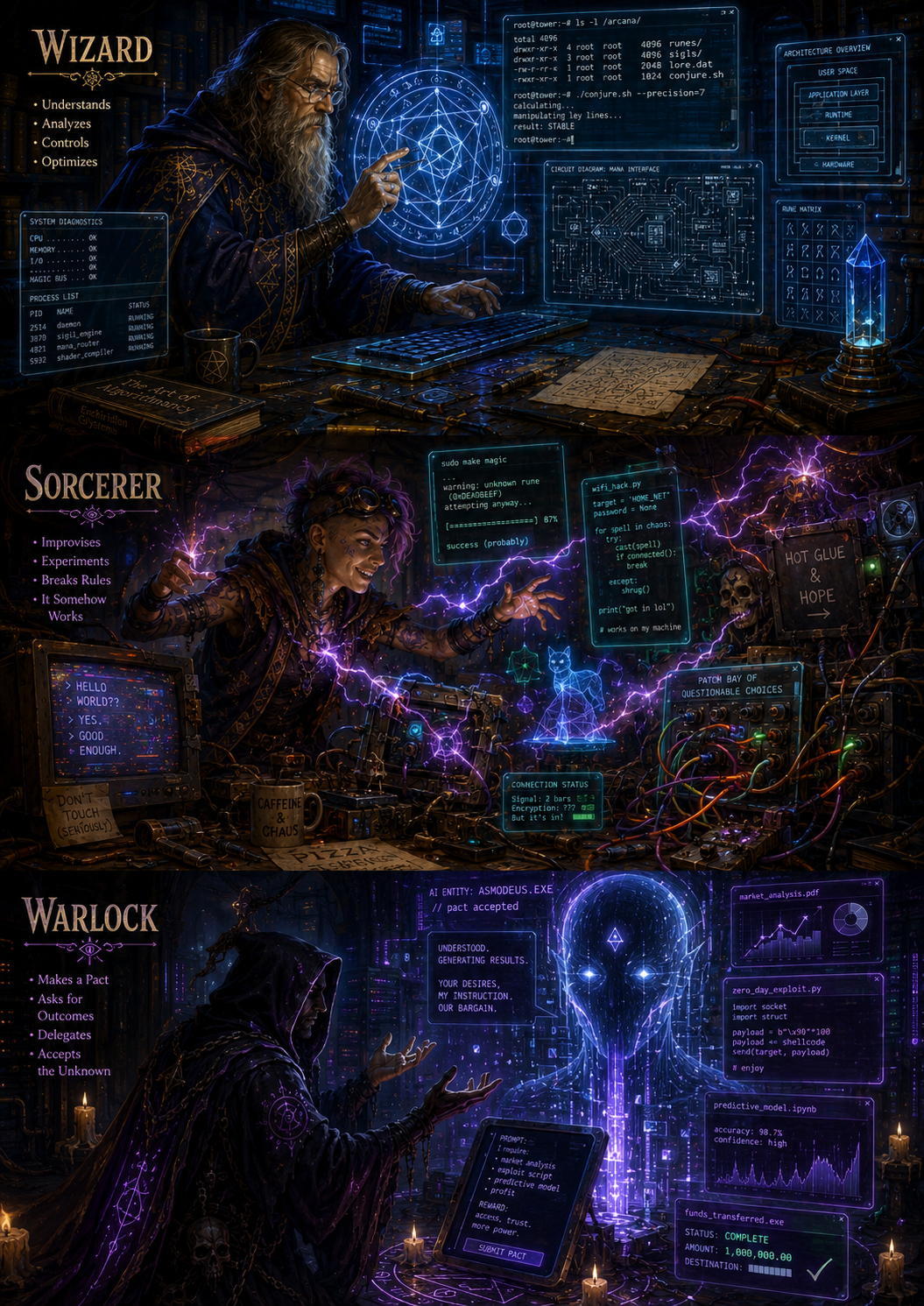
Wizards understand the system mechanistically. They know why a command works, what state it changes, what can break, and how to reason from first principles. They are exact, deliberate, great at creating complex solutions. For example, a wizard writes a database migration by understanding the schema and constraints.
Sorcerers just get things to work — kinda. They work through pattern, intuition, trial, half-knowledge, folklore, and «this incantation usually does it». The sorcerer may not understand the full mechanism, but still acts directly on the machine. For example, a sorcerer tweaks a database migration until the errors stop.
With the advent of AI writing code, I think there is a third category here: Warlocks. Not in the Wicca sense of oath-breakers, but in the RPG sense of making a pact with a powerful entity.
Warlocks do not primarily operate the machine directly. Instead, they negotiate with an intermediary intelligence that can operate the machine. They gain power by speaking intent to something stronger than themselves, while losing direct contact with the mechanism. The power comes from a pact — delegation, opacity, dependency, and the need to phrase desire in a way the entity can satisfy. For example, a warlock asks the AI to generate the migration, then tries it out and examines the effect.
That warlock approach is different from script kiddies — laypeople who find magic scrolls — or people who copy from Stack Overflow. The AI can bridge specific gaps, invent glue code, scaffold architectures, guess missing context, or produce something that looks like agency from the user’s side. That changes the user’s role from «operator» to «petitioner» or «contract negotiator».
The warlock metaphor also has useful built-in implications:
- A warlock can be powerful without being competent in the underlying craft.
- The pact grants leverage but creates dependency.
- The entity may fulfill the letter of the wish while violating the spirit.
- The result may work locally while hiding debt, fragility, or danger.
- The central skill becomes not command of the system, but command of specification, constraint, verification, and correction.
This is different from a wizard who is able to evaluate the code an AI generates, or a sorcerer who might notice when «something isn’t right». The warlock delegates power through an opaque agent. So AI introduces a new practical relationship to computation — not knowing the system, not merely improvising with the system, but bargaining with an intermediary that translates intent into operations.
AI makes «programming without mechanistic understanding» much more scalable. Earlier versions existed — copy-paste coding, no-code tools, macros, recipes — but AI adds a responsive, generative intermediary.
Looking around online, the warlock idea for AI usage is not new; e.g., it was used on Reddit and LinkedIn. But yeah, the distinction between wizard as mechanistic understanding, sorcerer as intuitive/experimental manipulation, and warlock as delegated power through an opaque intermediary is quite interesting.
ChatGPT did create a nice graphic:
though I like the illustration as well: