«As a well-spent day brings happy sleep, so a life well spent brings happy death.»
Leonardo da Vinci
Some people know exactly what they want to achieve with their creativity and focus their creative energy accordingly. They work directly on projects that bring them closer to that goal. Examples include becoming an accomplished musician, a cherished writer or beloved painter, having a successful career in science or engineering, or bringing a bit of creativity into people’s everyday lives.
However, strong focus also comes with high risks. Creative work is hard to plan long-term. The creation of new and useful things means that nobody knows in advance whether something will work — whether it is possible and will be accepted. Conditions can also change quickly, e.g., through technological development or societal shifts. Creativity is not like advancing in a bureaucratic organization where stable conditions and promotion criteria show a clear path.
If that creative goal turns out to be unreachable,1 or worse, not as good as one had imagined,2 then it can feel as if a great deal of time and energy was wasted. That makes it hard to decide on a creative direction, and even harder to decide which projects to pursue.
However, creative direction can be treated like an expedition into the unknown. You may have an aspiration (e.g., «write books», «make art»), but there are many different ways to move in that direction. Many of them are equally valid, authentic, interesting, and productive.3
Under these conditions, a Wayfinding approach can be a viable option. It treats creativity as a lifelong process that can be influenced to a degree and aligns aspiration, creative projects, and daily practice. Wayfinding is not the only valid way to orient creative work, but it is a useful model when long-term planning is too brittle and drifting is too costly.
It consists of having an aspiration that provides orientation even though it can never be reached, determining waypoints, i.e. reachable and plannable projects, and having a daily practice, i.e. actions that advance those projects and are aligned with the aspiration.
While wayfinding clarifies direction, it does not by itself solve how attention and energy are distributed across multiple competing projects. That is a separate problem (see Cre-ative Energy on page 165).
Aspirations
An aspiration provides direction, but in contrast to a goal, it has no end state, so it can never be achieved. For example, «Pursue mastery in telling stories of tension and revelation that make complexity engaging.» is an aspiration.
Once identified, an aspiration provides orientation and supports improvement via a strategic lifetime perspective that outlives individual projects. An aspiration can shape identity and give continuity, but it should not harden into a prestige self-concept that must be defended (see Aspiration Becomes Identity on page 159).
That an aspiration can never be achieved is a feature, not a bug.
Like a star in the sky, it provides guidance — the «why». A clear purpose, a vision, a perspective for the future. But it does not constrain action in the way a concrete goal would, and because it cannot be reached, it remains available to you long-term. Thus it is more flexible and enduring, which fits a world that is hard to predict. And it is often intrinsically motivated through meaning or improvement.
For some people, their aspiration is obvious. It is simply a drive they have — to paint or dance, to find out, or to build. For others, it reveals itself in where their ideas cluster, which leads to specific projects that point to a common theme. They discover it only after wanting to do a specific project — for example, writing a particular book — and then finding out that they enjoy the practice and want to continue. Sometimes it also grows out of life circumstances, e.g., working in a particular domain or field, or a family situation that nudges a person in a certain direction until it is consciously embraced. An aspiration does not have to be a single grand calling. It can also take the form of a recurring theme, question, or direction that organizes your work over time.
An aspiration is more likely to work if it is meaningful to you, fits your strengths well enough that excellence is possible through practice, and creates something of value for others. Desire, craft, and will come together here (see Person on page 51). External response can be one reality check among others — whether people read it, use it, support it, recommend it, or pay for it.4
In most cases, an aspiration also implies a domain (e.g., fiction writing) and a field (e.g., mystery readers), and therefore provides a concrete direction.
Whether an aspiration actually works for you is seen in practice — whether the waypoints are reached and whether the daily practice is sustainable. Reality is often different from what one expected, and many glamorous professions come with highly negative aspects as well. Additionally, the aspiration has to fit with other life goals, e.g., health, partner, or family.
Waypoints
Waypoints are concrete projects chosen on the basis of the aspiration, the current situation, and the body of work one is building. A body of work is the series of realized projects that belong together over time. It is larger than a single project, but more concrete than an aspiration.
As such, waypoints are reachable goals that support the aspiration and are either reached or not. This places them on the tactical level and ensures that an aspiration has practical consequences. For example, writing a specific novel, building a prototype, publishing an essay series, releasing a game scenario, or completing a non-fiction book.
A good waypoint can be chosen by comparing the available options and selecting a project that advances the aspiration most, puts the person in a better position for the direction that has actually been chosen, without foreclosing too many future options.
However, worthwhile projects may build different bodies of work. A novel, a research paper, a tool, an essay, and a performance may each be good projects. But they do not necessarily require the same capabilities, address the same field, or build toward the same future. Thus, choosing a waypoint often means making a decision which body of work the person wants to build in their limited lifetime (see Creative Finitude and Limits).
Some waypoints are central as they directly develop the body of work. Others are supportive as they strengthen capabilities, visibility, infrastructure, or understanding that the direction needs. And some are distractions, even if they are interesting, because they would consume attention without sufficiently strengthening the aspiration or the body of work.
A waypoint should be both challenging and achievable. Risk and reward need to be considered in order to select a waypoint that puts you in a better position. It should also have the right scope — large enough to matter, but small enough to be reachable under current conditions. If it mainly explores an adjacent direction, the waypoint should usually be smaller — an essay instead of a book, a short story instead of a novel, a prototype instead of a platform, or a scenario instead of a whole game line.
As concrete projects, waypoints determine the knowledge and skills that are needed, including which new skills, mentoring, guidance, or networking may be required. They are also close enough in time to allow pragmatic planning: How to reach the goal, which milestones make sense, which resources need to remain available, and what can be used as feedback on progress.
Because things often change during realization, deviations are possible. For example, a series of essays may turn into a book. Often the work can even be improved by using iterative waypoints. One might first publish the essays, then use reader feedback to turn them into a better book as the next waypoint.
Done well, waypoints provide meaning. You achieve something concrete by realizing them, demonstrate competence, improve craftsmanship, and develop self-efficacy.
Once a waypoint is either reached or the kill criteria are triggered, e.g., progress is too slow or the waypoint is no longer reachable, a new waypoint is selected. By then the situation has changed — you learned during the project, the environment changed, and the domain and field shifted. And because the aspiration preserves overall direction, the next waypoints are not only different, but often more challenging and interesting.
That is how you go farther in the right direction.
Practice
Daily practice5 is where aspiration and waypoints become actionable — the embodiment of creativity. The concrete waypoint makes it possible to focus on the present — on what needs to be done today in order to make progress, and on how close one is to reaching it.
The focus is on reaching the next waypoint, i.e. completing the current project. Thus, you can see when you are getting closer, and daily practice is aligned with the waypoint and through it with the aspiration.
Because drift and entropy over time are likely, regular reflection and correction are needed to stay on course or adjust it. While the waypoint is fixed, the methods used to reach it can be changed if needed, e.g., tools, routines, or working methods.
In practice, this means investing at least the minimum amount of time and effort needed to make meaningful progress toward that waypoint. Even with an unpredictable life, it is often possible to block a few hours and reserve some energy on workdays. The point is to establish routines so the work becomes a normal element of life, i.e., time for ideas, for generating and capturing, and protected time for creation.
For example, doing two deep-work phases each workday to make progress on a novel. The concrete work can differ depending on the phase of the project — broad research into themes such as forensics or psychology, long walks to enable associative drift, working on an outline to get the structure right, or long focused writing sessions.
If practice aligns with waypoints, you can embrace the journey.6 You know that the daily practice is moving you toward your destination, and you can enjoy discovery, personal growth, and learning. You celebrate concrete achievements and learn from clear setbacks.
Doing Wayfinding
Wayfinding still involves planning and decision-making, because it covers long- (aspiration), mid- (next waypoint), and short-term (daily practice) perspectives. But it does not require a static long-term plan that is unlikely to hold.
Instead, it is iterative — both fixed (aspiration, current waypoint) and flexible (future waypoints). It also removes the pressure to «get it right», to find the one best path that is unlikely to exist at all, or at least is unlikely to remain stable long enough to be useful.
Thus, you can look at the current situation and the next possible projects (waypoints) and choose the one that best supports your aspiration (see Figure 11). The aspiration provides orientation, which prevents blundering around by simply going for what sounds good in the moment. It also encourages progress and improvement by making more demanding waypoints visible over time. Life has a direction, you develop as a creative person, and the completed waypoints become a portfolio of your work.
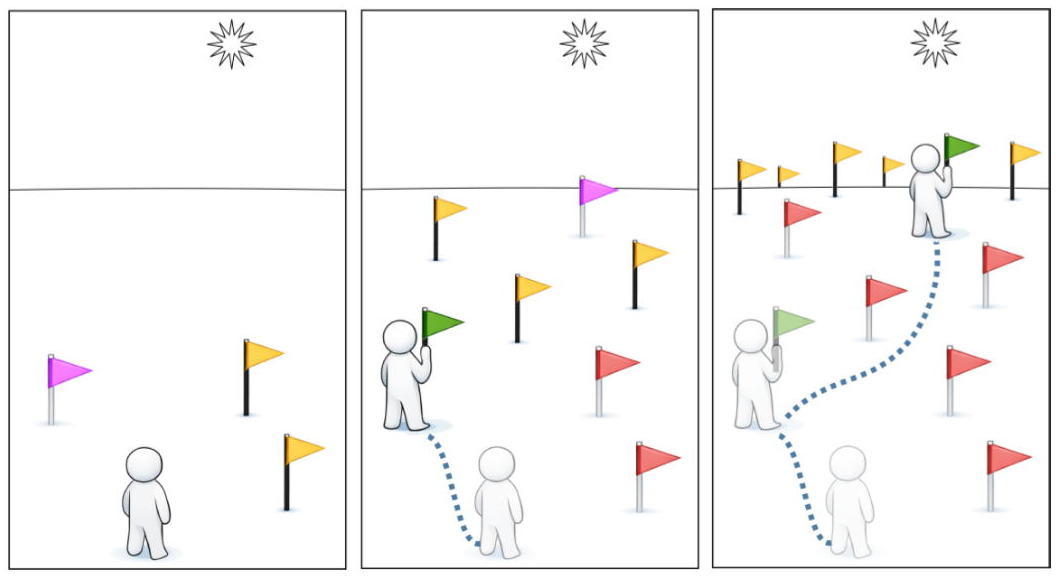
Figure 11: Wayfinding. Left: Examine possible waypoints (projects, yellow), pick the one that best supports the aspiration (star; here the violet flag, see Rubicon). Middle: After reaching that waypoint (finished the project; green), new waypoints can be reached (project ideas) and some are no longer available (red). Faced with the new situation, the next waypoint that best supports the aspiration is selected (violet). Right: After reaching the next waypoint the process repeats.
Creative Finitude and Limits
Wayfinding becomes more difficult when there is not just one possible direction, but several. The aspiration may be clear enough to guide work, and the next waypoint may be reachable, yet different possible bodies of work can still compete for the same finite life.
This is the problem of creative finitude.
Because a life is finite, there are limits on what can be pursued. Even a well-functioning creative system cannot realize every valuable possibility. In fact, the better ideas are generated, captured, and collected, the more clearly this limit becomes visible. A good system prevents accidental loss, but it cannot remove the need for deliberate loss — some good projects will not be realized, or not by you, or not now.
This is true even within a single creative direction. If you want to write books, you will still not write all the books you could write. At some point, one book will be the last.7
It applies even more strongly if multiple creative directions are possible. Ideas and possible projects may cluster around different long-term directions, each of which could become a serious body of work. One might be drawn toward fiction, scientific work, game design, essays, tools, teaching, or art — and each direction could be meaningful, fitting, and useful.
Multiple creative directions can each generate plausible projects, require different capabilities, imply different audiences, and develop the person in different ways. Choosing an aspiration narrows these possibilities, but often does not decide them completely. A broad aspiration may still support several possible bodies of work. Thus, creative direction also requires deciding which body of work is actually being built — and therefore which creative life is currently being lived.
This is a limitation of a bounded life, not a failure of creativity or of the creative system.
For example, «pursue mastery in telling stories of tension and revelation that make complexity engaging» might support several bodies of work — mystery novels, essays, role-playing scenarios, films, or narrative non-fiction. All may fit the aspiration, but each develops a different life. Choosing one does not prove that the others were false, but only recognizes that a life cannot be lived in all directions at once.8
Following one creative direction allows a body of work to develop over time — a series of realized projects that belong together, strengthen each other, and make later work easier or more visible. Skill accumulates, standards improve, references become reusable, and others can begin to understand what kind of work to expect from you.
Deciding on one creative direction and selecting projects accordingly allows you to ask:
- Which body of work would this project belong to?
- Does this body of work support my current aspiration?
- Am I actually building this body of work, or only attracted to the possible identity it suggests?
- Would realizing this project put me in a better position for the creative life I am actually living?
- Can this direction be represented by a smaller project instead of becoming a major commitment?
Thus, wayfinding requires limits. Without them, too many possible directions remain active, and the person is pulled between several creative lives. The result looks like abundance, but functionally it reduces what can be achieved over a lifetime.
Lives Not Lived
The focus on one creative direction makes the realized work more impactful and more likely to succeed. However, the unchosen creative lives can still hurt. It is easy to imagine «what would have been», because the imagined life is unencumbered by the friction that going in that direction would have brought. Still, there are ways to reduce the pain.
Some possible creative lives do not need to be lived fully in order to be honored. They can be represented by an emissary project, i.e., a small, bounded artifact that gives the direction a concrete form without letting it dominate the system. For example, a short story may represent a larger fiction direction, a single essay may represent a philosophical direction, or a small game scenario may represent a game-design direction. Side projects (see Creative Energy on page 165) are well suited for this approach.
Other directions may need sanctuary. They are serious enough to be acknowledged as valuable, but are kept in a way that prevents them from interfering with daily practice. They can be preserved in a dedicated part of the idea collection and revisited after specific waypoints have been reached. In contrast to cold storage ideas or active projects, the sanctuary preserves a possible direction without pretending that it can be lived now.
Some directions should be consciously relinquished. Not every interesting possibility deserves a continuing claim on attention. This means recognizing that — given the aspiration, current body of work, and finite life — it will not be pursued. Relinquishing them to cold storage prevents the collection from becoming a place where unlived lives accumulate as quiet accusations.
Thus, creative direction often also means deciding which possible creative lives are lived, represented, preserved, or relinquished.
Common Failure Modes of Wayfinding
Wayfinding also has its own risks, which lead to several common failure modes.
Aspiration Becomes Identity
An aspiration should provide direction, e.g., «Pursue mastery in telling stories.» But when an aspiration becomes an identity, it stops functioning as orientation and becomes a self-concept that must be defended. An identity such as «I am a writer» replaces writing books, and anything that challenges that image is resisted because it feels like ego death.
Typical signs are that people cling to the aspiration-identity because it is usually a glamorous prestige identity that flatters them, they avoid evidence that the actual practice does not fit, keep the label while not doing the work, or reject adjacent directions because they seem «beneath» the identity.
For example, if someone sees himself as a novelist, then writing non-fiction may feel as if it challenges that identity. Exploring that form of writing would seem like failure rather than expansion. This way identity becomes a trap that prevents both creative work and its improvement.
Thus, keep the aspiration as a guiding star, not as an identity.
Aspiration Is Too Abstract
An aspiration can never be reached, but it still has to be concrete enough to guide behavior. Abstract aspirations such as «I want to tell the truth», «I want to inspire humanity», or «I want to create meaningful things» provide too little guidance about which waypoints to choose. They rule out too little.
Thus, an aspiration has to reduce options, generate waypoints, and constrain practice.
Too Many Possible Lives
Sometimes a person can imagine several creative lives that would be worth living. Each has real appeal, each generates projects, and each can be defended as meaningful. The person is pulled in multiple directions at once.
Typical signs are that ideas cluster around several incompatible bodies of work, that every project seems justified, that already-made decisions are repeatedly reopened, or that side projects become covert attempts to start another creative life. The person may still complete work, but the overall direction becomes unstable. Too much attention is spent deciding what kind of creator to be.
The issue is which long-term direction is actually being lived — something that cannot be solved by just choosing the next project.
One intervention is to classify the competing directions explicitly9 — primary, supporting, emissary, sanctuary, or relinquished. The important point here is that the classification must be deliberate. It acknowledges the value of other directions while preventing them from quietly overruling the one that has been chosen. Otherwise each attractive idea can present itself as an exception, and the same decision has to be made again and again.
Thus, if several creative lives are possible, decide which one is currently being lived — and classify what status the others have.
Waypoints Become Detached from Aspiration
Waypoints may be chosen by mood, glamour, or convenience rather than by fit to the aspiration. While occasional exploratory or just-for-fun projects can be useful (see Cre-ative Energy on page 165), haphazard project choice wastes too much energy and produces too little progress.
This can also happen when several possible bodies of work compete. A project may fit one possible creative life very well, but not the one currently being lived. For example, a short story, a product idea, a performance, or a research question may be genuinely promising, but still pull attention away from the primary direction. So the quality must not decide the issue by itself.
Instead, a project should be chosen with the questions: «Which aspiration and body of work does this project serve?» and «Is this the project that makes the greatest progress toward that direction and puts me in a better position once I have realized it?» If the answer is no, the project may still be kept in sanctuary, turned into an emissary project, or relinquished — but it should not automatically become the next waypoint.
Disconnected Practice
Some people like the image or prestige of an aspiration or waypoint, but not the daily reality required to sustain it. They want to have done the work — having written that book, having given the performance — without wanting the daily practice that would be required. This is especially true of glamorous professions whose actual practice is often repetitive, lonely, tedious, physically static, or socially difficult.
This does not mean that missing or inconsistent daily practice automatically invalidates the aspiration. In some cases, however, the mismatch can be more easily addressed by determining a different aspiration, one that aligns with what a person is actually willing to do each day. In other cases, it may be because you do not yet know how to reach that waypoint, or because you have not yet developed the skills to do so. In such cases, changing the scope can help — reducing it to something easier to achieve. For example, writing a blog post instead of a book. Choosing the right scope can be used to strengthen one’s capabilities.
Thus, check whether you can actually sustain the practice required by the aspiration and the current waypoint. Regular practice is truthful here. If not, change the aspiration or adapt the waypoint.
Underflow, Optimal Flow, and Overflow
Flow problems can occur in the three aspects of wayfinding and in creative finitude and limits (see Table 15).
| Aspect | Underflow | Optimal Flow | Overflow |
|---|---|---|---|
| Aspiration | no clear direction, blundering around, little directed progress | clear, desired, and possible aspiration, clear primary direction, others are supporting, represented, preserved, or relinquished | premature narrowing, locked into a specific career path or goal, high risk if that goal is not reached or not as good as expected |
| Waypoints | next project is chosen by mood or by what seems easiest | deliberate selection of the next waypoint based on aspiration and current position | rumination and analysis paralysis, inability to abandon waypoints that no longer make sense |
| Practice | no consistency, starting and abandoning work frequently | practice aligned with aspiration and waypoints, with time for other activities | overscheduled, too much focus on creative work, life becomes brittle |
| Creative Finitude and Limits |
limits are not set; too many possible lives remain eligible; decisions are repeatedly reopened | finite life is acknowledged; directions are lived, represented, preserved, or relinquished | premature narrowing; excessive pruning; valuable directions are excluded before they are understood |
Table 15: Creative Direction — underflow, optimal flow, and overflow.
Even if you do not do wayfinding, looking at where you want to go and what you are doing each day is usually enlightening. The supplemental materials, especially the ▯ Integration Worksheet, can be used to test whether changes align better with your overall goals.
Where it fits into your current creative process:
- Update your ▯ Creative System Map.
- What is your aspiration, what is your next waypoint, and how well are they connected to your actual practice?
- Are the projects you are doing now what you want to leave behind?
- Mark whether it constrains output, i.e., is a potential candidate for an ▯ Integration Worksheet trial.
Endnotes
- For example, due to injury (e.g., in singing or dancing), changing conditions (e.g., no open positions), or simply limits of one’s abilities (e.g., competition is much better). ↩
- As Mr. Spock put it in Star Trek TOS: «Having is not so pleasing a thing as wanting, it may not be logical but it is often true.» ↩
- Burnett & Evans (2016). ↩
- Depending on the domain and the field, money can be one signal that is often informative, though not always decisive. There are domains and fields in which it does not work — e.g., intimate relationships — but in others it can be quite truthful. Beautifully put in «Magic Inc.» by Robert A. Heinlein: «Why do some people act as if making money offended their delicate minds? I am out for a legitimate profit, and not ashamed of it; the fact that people will pay money for my goods and services shows that my work is useful.» ↩
- Practice might sound strange, but it emphasizes ongoing, lived enactment rather than task completion or box-ticking. That fits very well to aspiration. ↩
- Akin to Schroeder’s (Peanuts) «The joy is in the playing.» ↩
- Even Isaac Asimov’s «If the doctor told me I had six minutes to live, I’d type a little faster.» only gets you so far. ↩
- Beautifully put by William James: «I am often confronted by the necessity of standing by one of my empirical selves and relinquishing the rest. Not that I would not, if I could, be … a great athlete and make a million a year, be a wit, a bon-vivant and a lady killer, as well as a philosopher, a philanthropist … and saint. But the thing is simply impossible. The millionaire’s work would run counter to the saint’s; the bon-vivant and the philanthropist would trip each other up; the philosopher and the lady killer could not well keep house in the same tenement of clay. Such different characters may conceivably, at the outset of life, be alike possible for a man. But to make any one of the actual, the rest must more or less be suppressed. So the seeker of truest, strongest, deepest self must review the list carefully and pick out one on which to stake his salvation. All other selves thereupon become unreal, but the fortunes of this self are real. Its failures are real failures, its triumphs real triumphs carrying shame and gladness with them.» ↩
- This is different from project segmentation in Creative Energy. It is on the creative direction level and determines which projects are considered with which scope in the first place. ↩
Supplemental Materials
OC3 Navi
- Home | Front Matter
- Why Organize Creativity
- Creativity as a System: 1. Creativity, 2. Creative System, 3. Application, Meta: Supplemental Materials
- Framework: Foundation: 4. Person, 5. Environment, 6. Capabilities, Meta: Tools
- Framework: Ideas: 7. Generating Ideas, 8. Capturing Ideas, 9. Collecting Ideas
- Framework: Creative Focus: 10. Creative Direction, 11. Creative Energy, 12. Creative Commitment
- Framework: Projects: 13. Project Realization, 14. Project Evaluation, 15. Project Release
- Back Matter: Afterword by the Author, Afterword by AI, Sources and Foundations, References, About the Author, Feedback and Saying Thanks, Glossary, Appendix