«What is worth having is worth working for.»
«His Dark Materials» by Philip Pullman
The book itself focuses on the invariant aspects that apply to almost everyone who wants to be creative. It functions like a map. The supplemental materials operationalize and, where needed, extend this framework. Separating them from the book keeps the book shorter and the framework more universally applicable. It also allows easier updates, as specific tools can become outdated quickly.
Thus, the supplemental materials serve two functions:
- Reference material: a toolbox of options rather than a set of recommendations or methods to master (e.g., more detailed information on possible interventions, creativity methods, or capturing methods).
- Operational instructions: tools used to specify and run trials, and thereby to improve your existing creative system.
They are the toolkit of this book, meant to be used selectively depending on your concrete needs. Without them, the book is still useful, but less concrete in application.
However, they are only a means to an end — tools for modifying specific elements of your system in order to improve the quality and quantity of your creative work. You do not need to work through them exhaustively. They exist to provide examples and options if you want to explore a particular area more deeply. The ▯ Creative System Map and the ▯ Integration Worksheet are recommended for almost everyone. Of the remaining materials, most readers will likely use only a small subset relevant to their current work. More than that would likely be displacement behavior.
At the end of each chapter, you will find a link to a page containing all supplemental materials relevant to that chapter. The complete list is:
Worksheets
Booklets
- Backups
- Capturing Ideas
- Collecting Ideas
- Constraint Planner
- Creative System Reset
- Creativity Methods (Website)
- Digital Environment
- Digitizing Information
- Dissent, Whistleblowing, and Exit
- Domains
- Eccentricity and Mischaracterization
- Epistemic Humility and Viewpoint Diversity
- Ethics in Creativity
- Inspiration and Insight
- Mistakes and Dealing with Them
- Night Architecture
- Productivity, Time- and Task-Management
- Promoted vs. Works for You
- Remembering People
- Responsibility and Integrity
- Saying No
- Seeing Things Differently
- Sleep
- Using AI for Creativity
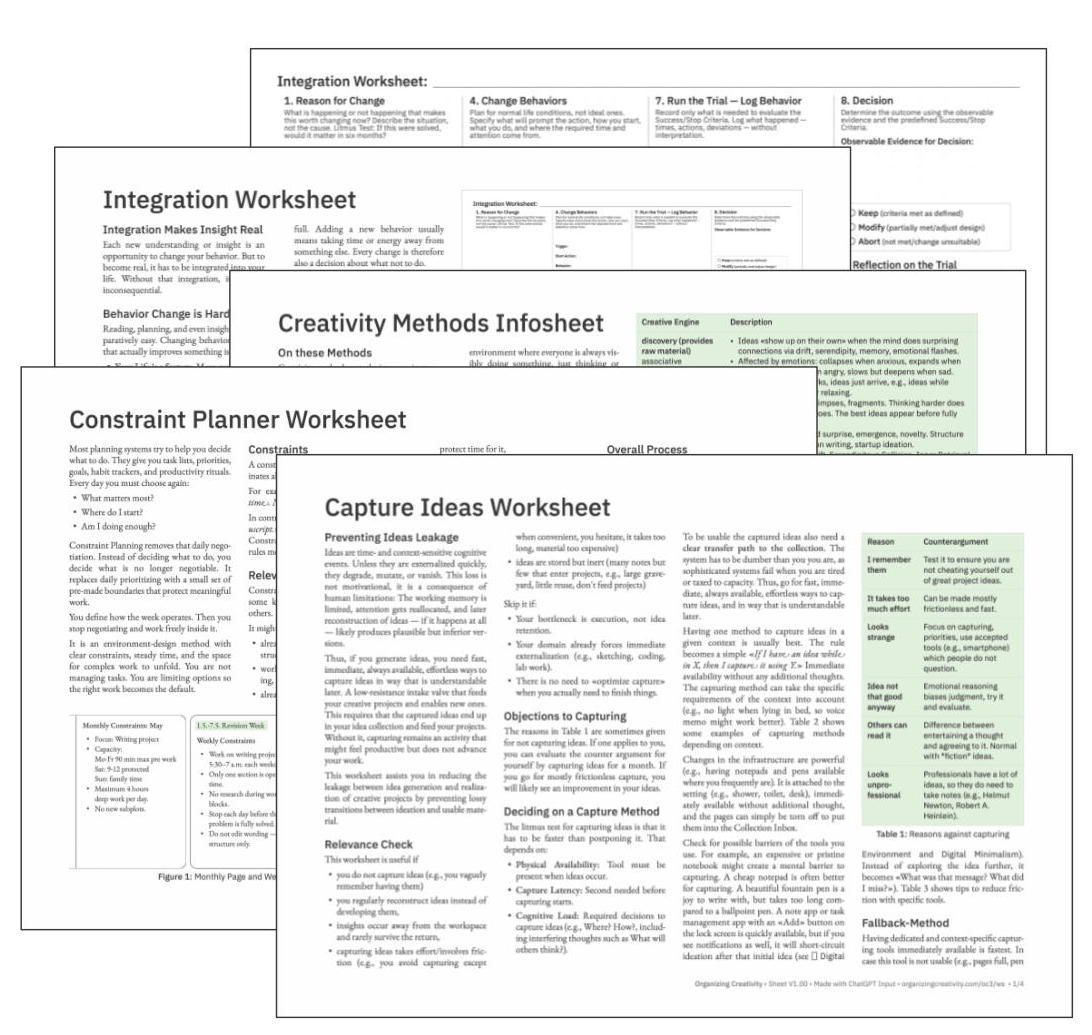
Examples are shown in Figure 4.
Something Missing?
If you would like to see a specific topic covered, have questions or comments, or know of another approach that works and might be worth including, please drop me a line at:
danwessel@organizingcreativity.com
OC3 Navi
- Home | Front Matter
- Why Organize Creativity
- Creativity as a System: 1. Creativity, 2. Creative System, 3. Application, Meta: Supplemental Materials
- Framework: Foundation: 4. Person, 5. Environment, 6. Capabilities, Meta: Tools
- Framework: Ideas: 7. Generating Ideas, 8. Capturing Ideas, 9. Collecting Ideas
- Framework: Creative Focus: 10. Creative Direction, 11. Creative Energy, 12. Creative Commitment
- Framework: Projects: 13. Project Realization, 14. Project Evaluation, 15. Project Release
- Back Matter: Afterword by the Author, Afterword by AI, Sources and Foundations, References, About the Author, Feedback and Saying Thanks, Glossary, Appendix