«… an honest-to-God artist who can paint — and works at it. One who doesn’t spend his time sopping up sauce or blowing weed, and talking about the painting he’s going to do. Joe paints. He’s a craftsman as well as an artist. Well, maybe I don’t know what an artist is but I know what a craftsman is and I respect craftsmen. Too few of them in this decadent world.»
«I Will Fear No Evil» by Robert A. Heinlein
The person is the individual who does the creative work,1 and many attempts to improve creativity focus here. Personal attributes influence what is possible and define tolerances — for example energy, working style, cognitive limits, or social preference.
These attributes matter in practice. Some modes of idea generation, for example, depend on capacities that not everyone has to the same degree. Internal simulation requires strong internal imagery — without it, the image collapses too quickly. Some domains and fields also impose hard requirements, such as the hand coordination needed to play a harp.
However, attributes are not destiny. If one ability is weak or unavailable, alternatives can often be found — for example, externalization instead of internal imagery. Nor are attributes universally positive. Curiosity expands the search space, but unchecked curiosity diffuses effort. Discipline supports realization, but in excess becomes rigidity.
It therefore makes little sense to describe the ideal creative person or to compile a catalogue of supposedly desirable traits. That invites self-deception. It is too easy to imagine oneself in flattering abstractions.
What matters is not who one imagines oneself to be, but which attributes are actually required, over time, for the work one is actually trying to do.
The focus of this chapter is therefore not personality judgment, but design. Where do a person’s attributes support the work, where do they impede it, and where do they need more experience, training, support, compensation, or delegation?
If person and work are misaligned, that is not a moral failure — just a design problem that can be solved.
Creative Spark vs. the Right Niche
One attribute often treated as essential to creativity is the special «creative spark». And yes, raw ideational potential is unequally distributed. For some people, generating ideas is simply easier. They have a higher associative range, unusual perception, or forms of insight that open doors others do not even see.
However, this mainly affects particular ideation modes and the domains that rely on them. Some ideation modes fit some people much better than others. Associative drift, for example, benefits from high associative range and ambiguity tolerance. Constraint-driven exploration relies more on inhibition control, conscientiousness, and deliberate variation. The mistake is to assume that there is only one truly creative way to generate ideas, or that one mode is inherently superior.
What matters is fit. Some people are excellent in one domain and poorly suited to another. That is not a personal failure, but a mismatch between the individual and the mode or domain. In addition, having ideas is only one part of creative work. Ideas still have to be realized, which requires knowledge, skill, persistence, and other decidedly «non-sparky» attributes. So even gifted individuals or «sparks»2 cannot bypass the actual work.
So «the spark» is not the whole story. Creativity is not reserved for a gifted elite. What matters is finding the right niche, the right mode, and the right constraints under which a person can deliberately create something new and useful.
Attributes to Design For
Which attributes influence the creative process and should therefore be treated as design constraints — to rely on, improve, compensate for, or delegate?
What is needed, across the whole process from building the foundation to generating ideas, to focusing on a few, and realizing them in projects, can be grouped into three sections: desire, craft, and will to create.3 All three must work sufficiently well together if something alive is to emerge.
Desire to Create
There has to be a desire to create. Energy has to enter the system at all and be directed toward a specific project. That desire can be intrinsic — e.g., seeing things differently or feeling an urge to create — or extrinsic, e.g., wanting money or fame. Intrinsic motivation is usually stronger and more persistent. However, while powerful, desire is also fickle and can burn you out quickly if it is not handled carefully.
Relevant aspects of desire are:
- Meaning: The underlying «Why» as a motivator, especially during hard or tedious project phases, learning, and habit change. It connects the person to something larger than the self — for example discovery, beauty, human ascent, or the glory of God — and provides purpose, coherence, resonance, and significance.4 If meaning matters, it includes the possibility of failure and actually costs something (see also Creative Focus on page 147).
- Curiosity: The desire to know, to try out, and to find out is a powerful mechanism for idea generation. It includes a «What if?» or improvement mentality. Curiosity can be natural, or it can be supported with ideation techniques. Overflow can be kept in check by defending core work phases and seeking variety within a topic.5 Expertise can also undermine curiosity if the false belief that one already knows what will happen prevents further exploration.6
- Regulation and Play: The ability to deal with negative outcomes — e.g., mistakes, failures, or tedium — as well as exuberant positive emotions. It is also useful for shifting into the right stance for the work, e.g., more playful for generating ideas or more focused for realization. While verbal processing is often promoted for emotional regulation, other approaches can work better. Humor and playfulness are especially useful regulators of fear, brittleness, and narrowness. They cushion setbacks, widen the design space by widening the mind, and counter anger and fear, including fear of mistakes. If humor comes from a good place, it is also a strong indicator of a non-toxic workplace.
While desire is necessary, this does not mean «follow your passion». Passion does not care about reality — about skill, demand, or fit — and during most creative projects, passion alone will not get you across the finish line. If passion is your guide, it becomes hard to finish projects once that passion is gone, whether temporarily or permanently.7
Craft to Create
When people are motivated to create, they need craftsmanship to make that work possible. Actually converting energy into usable work goes far beyond «being inspired». Inspiration can help with idea generation, and the conditions for it can be shaped. But creative work requires much more than that. It needs a great deal of plain craftsmanship to turn ideas into realized projects.
That craftsmanship requires knowledge and skill. You have to work with something, be able to do something, and know what has already been done and why. Consider Kekulé’s discovery of the benzene ring. He had a dream of a snake biting its tail, which led him to consider the form of a ring. Sudden insight after incubation? Yes. Was knowledge unnecessary? No. He had extensive knowledge of chemistry and had thought about the problem for a long time with that knowledge in mind. Yes, he gave his mind time to relax and work it out, but he first invested heavily in learning what there was to learn.8
Relevant aspects of craft are:
- Domain Knowledge and Skill: Acquiring the necessary knowledge and skill is a lifelong process that takes hard work and time (see Capabilities). The interest in learning the domain and working in it — not just in having done so — has to be strong enough. This includes fundamentals as well as the deeper principles behind them. Relationships, models, application, and principles usually beat procedure or rote learning. It also requires that the work in the domain be at least doable, especially regarding hard barriers such as perceptual-motor capacities. The main ideation modes valued in the domain and required by the field should fit the individual reasonably well, or be easily compensated for.
- Competence: The capacity to realize ideas under real constraints. Without domain competence, the risk of illusory competence is high — ideas that appear elegant in abstraction, but fail under material, technical, temporal, or social limits. Execution may be direct (e.g., painter, research scientist) or indirect (e.g., creative director, principal investigator), but both demand deep fluency in the domain. Unless they are just managers, even those who direct work must understand the craft well enough to judge feasibility, trade-offs, and quality. Such competence usually develops through sustained practice, often extending well beyond formal education. With increasing competence, one no longer has to think consciously about every step. Skill becomes available when needed, and attention can go more deeply into the task. Expertise and intuition are often the result of knowledge and skill that can no longer be fully verbalized. Competence is also necessary for self-efficacy, the belief that one can achieve a goal through one’s own actions. Perfectionism, however, must be avoided, because it is both toxic and impossible (see Per-fectionism on page 60).
- Judgment: Craft depends not only on knowledge and skill, but on the ability to make good judgments under real conditions, including being sensitive to constraints. This begins with vigilance — noticing when things differ from what was expected, and when something important or promising is happening. Careful work makes such deviations visible — sloppy work hides them. It also includes perspective-taking — seeing the work from different relevant viewpoints, especially those of the target group or the field, without having to agree with every one of them).9 Critical and skeptical thinking are needed to test whether claims, impressions, or ideas are actually supported by evidence and argument rather than merely appealing. On that basis, decisions have to be made without drifting into rumination or overanalysis. Finally, because some judgments will inevitably be wrong, intellectual humility is needed — the willingness to learn from mistakes, feedback, and reality rather than rationalizing them away. In creative work, judgment means staying oriented toward what is actually there, correcting course when needed, and deciding well enough to keep the work moving.
- Discipline: Because many projects cannot be completed in a single burst, repeated engagement is needed — enough to make meaningful progress and eventually finish. Pacing — with breaks and break days — is as important as workdays. Discipline is also needed when the work becomes tedious or slow. Output may vary, but regularity should not. Work on every workday, even if only the minimum needed to maintain progress.
Will to Create
Because the creative work has to be new and useful, risk is unavoidable, and there is often pushback as well. Energy has to keep flowing when resistance increases.
Creative work therefore requires the will to create — to go for what you want despite friction, and to accept being seen failing in pursuit of something real. This only becomes visible once there is an opposing force — from the work, from yourself, or from others. And counterintuitively, it also includes the courage to quit when needed.
Relevant aspects of will are:
- Own Agenda: Being intentional about what you want to achieve — not only desiring something, but actually going for it. Despite others pushing you in another direction or wanting to use you for their own purposes. Ideally this agenda is intrinsically motivated and aligned with your values, ideas, and independent judgment (see also Creative Direction on page 149).
- Ambiguity Tolerance and Courage: Creative work involves risk. Because the work is new, success is never guaranteed, and the duration of unsuccessful phases is often unclear. This requires ambiguity tolerance — the ability to continue working without premature closure, false certainty, or retreat into the merely familiar. It also requires courage — the willingness to act despite the possibility of failure, wasted effort, criticism, embarrassment, or pushback. A willingness to make mistakes belongs here as well. Finding out what works usually means first finding out what does not, whether in sketches, drafts, experiments, or behavioral trials. This does not mean blundering around or treating carelessness as a virtue.10 It means being willing to make defensible mistakes in pursuit of something real. Fear is not the enemy or a sign of weakness. It often marks what matters, and the arousal it produces is simply energy that can be channeled.11 But fear is destructive to creativity when it prevents creative work. It easily disguises itself as prudence — «not good enough yet», «do it later», «prepare a bit more» — and can thereby prevent completion. Courage in creative work is not the absence of fear, but the capacity to continue despite it.
- Opportunity Exposure: While you cannot design serendipity or luck directly, you can make the conditions for it more likely. People who were «lucky» were not dragged out from under their beds. They were already out there. They made themselves visible and available, so that when opportunities appeared, they were in a position to act on them.12 Good work that is never seen cannot be selected, supported, or used. You do not have to become loud, but you do have to become findable (see also Project Release on page 233). This applies not only to the creative work itself, but also to other aspects. For example, in learning the domain by finding mentors who recognize your value and can provide opportunities (see also Environ-ment on page 65).
- Self-Regulation, Persistence, and Resilience: Self-regulation is needed to control behavior even under stress. This includes planning, self-monitoring, emotional regulation, impulse control, goal setting, feedback, self-awareness, self-efficacy, and coping strategies. Persistence is needed to stay with one project despite distractions or reactance — whether from the work itself or from other people. A common threat is project-jumping simply because the grass looks greener elsewhere. A strong why helps during long uphill phases and periods of resistance (see Creative Focus on page 147). Resilience is needed in order to deal with hardships and stressors without disintegrating. Here again, a strong why helps.13 Small but constant stressors are often overlooked — the proverbial grain of sand in the boot. Removing them can provide disproportional benefits.
- Quitting Well: Because many ideas will not work out, resources should not be wasted on projects that can no longer succeed. This means avoiding zombie projects that only pull time and energy away from the ones that still could work. That does not mean quitting as soon as the work becomes tedious. Tedium is expected. What matters is whether the probability of success has become so low that a kill criterion is triggered — then quitting well is a virtue (see Creative Commitment on page 177).
Common Failure Modes of a Person
Three common failure modes on the level of the person are too many interests, perfectionism, and reactance against a near-perfect fit.
Too Many Interests
While many interests can benefit certain ideation modes — for example through serendipitous collisions — they also quickly disperse creative energy across too many areas, leaving too little for actual progress. This is common in learning, when people want to study too many disparate things at once, and in realization, when they try to pursue too many projects simultaneously.
Not choosing what to focus on is itself a choice — choosing dispersion over impact. A tiered approach can help Only begin learning something new once the previous topic has become self-sustaining. It also helps to distinguish clearly between projects that have crossed the Rubicon and those that have not (see Creative Commitment on page 177).
Perfectionism
Creative projects often have to satisfy multiple quality criteria that require trade-offs. A text, for example, has to be understandable, but also say something new, and be comprehensive enough. Optimizing one criterion usually weakens another. So the text can never be perfect on all criteria at once. Likewise, what counts as ideal differs across audiences and even within the same person over time. The creator changes while creating, so the standard of «perfect» is unstable as well.
Thus, the work can never be perfect — not for a moment, not for everyone, and not over time.
Because the work can never reach perfection, aiming for perfection means it will never be finished. In that sense, perfectionism is the death of creativity — and even God did not go for it.14
That does not mean quality does not matter. It does. What matters is threshold integrity — being clearly above the minimum standard for good work. But that standard is bounded by hard questions: How many resources can I invest? How polished should this be? How much? How fast? How consistently? At what personal cost? The aim is ethical craftsmanship — perhaps even beauty and excellence, where warranted — but never perfectionism (see Figure 5).
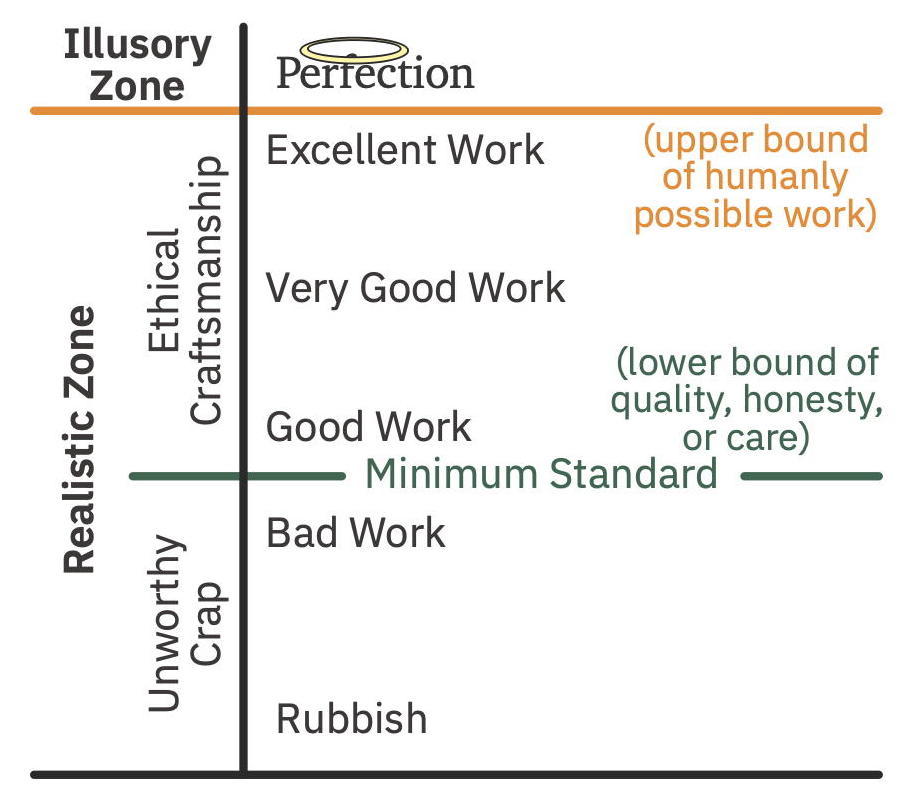
Figure 5: Ethical craftsmanship vs. perfectionism.
Reactance Against a Near-Perfect Fit
Sometimes a near-perfect fit between person and domain produces reactance rather than commitment. The obvious choice can feel imposed, especially when other people push for it. Then the need to choose for oneself conflicts with the feeling that the choice has already been made.
In such cases, it can help to keep plans private until they are settled. It can also help to remember that conformism and rebellion are often the same pattern in opposite directions — both let others determine the course.15 What matters is being willing to go for what one actually wants, both when others disapprove and when they wholeheartedly approve.
Underflow, Optimal Flow, and Overflow
Underflows and overflows can occur easily in the areas of desire, craft, and will. Table 6 and Table 7 show common examples.
| Aspect | Underflow | Optimal Flow | Overflow |
|---|---|---|---|
| Meaning | pointlessness, purely transactional work, no durable reason to continue | a strong why, connected to something significant enough to sustain effort | ideological possession, fanaticism, brittle overinvestment |
| Curiosity | little exploration, low questioning, narrow search space | active exploration, openness to surprise, directed variation | interest in everything, diffusion, endless exploration without realization |
| Regulation and Play |
overwhelmed by emotion, fear narrows the mind, no relief or recovery | emotional steadiness, ability to shift stance, humor and play support the work | emotional volatility, suppression, or fun displacing the work |
| Domain Knowledge and Skill |
missing fundamentals, weak fit to domain demands, too many compensations needed | sufficient knowledge and skill to work meaningfully and keep improving | endless learning without application, near-perfect fit triggering reactance |
| Competence | ideas fail in execution, large gaps between intention and realization | ideas can be realized under real constraints; skill becomes available when needed | perfectionism, fear of error, expertise narrowing vision |
| Judgment | blindness to feedback, weak criticism, poor perspective-taking, ad hoc decisions | alert, reality-based, open to correction, able to decide proportionately | overanalysis, skepticism about everything, paralysis, trying to satisfy every perspective |
| Discipline | only working when inspired, irregular effort, weak continuation | regular work with breaks and recovery, enough consistency for real progress | rigidity, compulsiveness, obsession |
Table 6: Person — underflow, optimal flow, and overflow (part 1).
| Aspect | Underflow | Optimal Flow | Overflow |
|---|---|---|---|
| Own Agenda | easily swayed, no stable direction, weak commitment | deliberate choice of direction, clear priorities, honest acceptance of costs | ruthlessness, disregard for others, scorched-earth behavior |
| Ambiguity Tolerance and Courage |
hesitation, avoidance, fear of failure or exposure, premature retreat from uncertainty | willingness to act despite uncertainty, stress, and possible pushback | recklessness, thrill-seeking, mistaking conflict for value |
| Opportunity Exposure | invisibility, avoiding exposure, never becoming findable | being present where opportunities can arise, visible enough to be found and selected | overexposure, pushiness, exhausting others, moving too fast to build trust |
| Self-Regulation and Persistence | distraction, instability, premature abandonment, weak coping | sustained effort, stress handled without collapse, persistence with flexibility | ossification, deafness to feedback, life organized around one project to a destructive degree |
| Quitting Well | continuing dead projects too long, sunk-cost capture | clear kill criteria, willingness to stop when success is no longer plausible | quitting when work becomes tedious, difficult, or temporarily unrewarding |
Table 7: Person — underflow, optimal flow, and overflow (part 2).
If you notice such an underflow or overflow during a project, do not panic. You have identified it — now you can design for it. Constraints often help — for example, shaping the environment to remove distractions, or getting social support such as accountability partners. Even a conversation with an AI can be useful. If necessary, you can change the scope or difficulty of the project, or delegate specific aspects of it in order to improve alignment without contorting yourself.16
People differ in which approaches to habit change work best. For some, streaks help — for others, they fail badly. Some can use things in moderation, others cannot. The supplemental materials, especially the ▯ Integration Worksheet, should help you determine what works for you. In general, habits are much easier to change through environmental design — making some behaviors easier and others harder — than through willpower alone.
Whatever you do, do it in practice while actually doing creative work, ideally in the context of a real project. A personality is not changed on a drafting board. Whether you are learning the domain, acquiring skills, generating ideas, or realizing, evaluating, and releasing projects, you will learn a great deal while doing the work. And your behavior will provide the feedback needed to improve.
Supplemental Materials:
https://www.organizingcreativity.com/oc3/chapter4
Where it fits into your current creative process:
- Update your ▯ Creative System Map.
- Ask yourself not who you are in the abstract, but how the way you work interacts with the demands of what you are trying to create.
- Mark whether it constrains output, i.e., is a potential candidate for an ▯ Integration Worksheet trial.
Endnotes
- Csikszentmihalyi’s (1996) model of creativity as the interaction of individual, domain and field. ↩
- A shout-out to «Girl Genius» (https://www.girlgeniusonline.com) for this term. ↩
- For a more symbolic representation, it is essentially the collaboration between Aphrodite (desire), Hephaestus (craft), and Ares (will). All three are needed. Note that in the Ancient Greek version, Aphrodite wasn’t soft-sweet fluffy-bunny love. Desire is powerful and has a dangerous side — it can destroy empires. ↩
- See Mekler & Hornbæk (2019). ↩
- If a person is interested in lots of different topics, then finding a wide-area topic that profits from these different interests can work. For example, photography covers classic art/painting (composition), chemistry (developing analog film), computer science (post-processing), physics (light), social skills (dealing with actual and accidental models), and much more. If all the sub-areas serve the main area (here: photography), any effort you invest in the sub-areas will also improve your work in the main area. Structured hierarchically, this way you can follow many topics, but each with the clear goal of improving your work in your (one) key area. ↩
- This is the curse of expertise. Well put by Arthur C. Clarke: «When a distinguished but elderly scientist states that something is possible, he is almost certainly right. When he states that something is impossible, he is very probably wrong.» ↩
- Sometimes you have to «Embrace the Suck» (verb, military slang): To consciously accept or appreciate something that is extremely unpleasant but unavoidable for forward progress. ↩
- Beautifully put in «His Dark Materials» by Philip Pullman: «It takes long practice, yes. You have to work. Did you think you could snap your fingers, and have it as a gift? What is worth having is worth working for.» ↩
- Functional diversity is what matters here — differences in needs, values, experiences, and viewpoints. Superficial sociodemographic diversity is of no value on its own if it leaves assumptions, interpretations, and judgments unchanged. And sociodemographic diversity is often used as a smokescreen to cover the lack of actual functional or viewpoint diversity. What improves the work are relevant differences in perspectives. That requires tolerating genuine disagreement, including fundamental disagreement. Aristotle put it well: «It is the mark of an educated mind to be able to entertain a thought without accepting it.» ↩
- While you cannot make an omelette without breaking a few eggs, breaking eggs with no intent to eat the omelette or knowing how to cook it is something else entirely. ↩
- Arousal is just that — arousal. That energy can be used for other purposes. For example, the arousal you feel before a presentation can be used as energy for that presentation. It is just a question of noticing that energy and redirecting it. ↩
- Nicely put in Star Trek TNG:
Picard: «Please. This is important to me. I believe that I can do more.»
Troi: «Hasn’t that been the problem all along? Throughout your career you’ve had lofty goals, but you’ve never been willing to do what’s necessary to attain them.»
Picard: «Would that be your evaluation as well, Commander?»
Riker: «I think I have to agree with the Counsellor. If you want to get ahead, you have to take chances, stand out in a crowd, get noticed.»
Star Trek TNG: «Tapestry» ↩ - Friedrich Nietzsche’s «He who has a why to live can bear almost any how.» ↩
- God did not go for perfect, «just» very good: «And God saw every thing that he had made, and, behold, it was very good_._» (Genesis 1:31, KJV, my emphasis) ↩
- As Paul Vixie put it: «Be neither a conformist or a rebel, for they are really the same thing. Find your own path, and stay on it.» ↩
- The design solution can be quite creative in its own right. For example, publishing under a pseudonym and putting controversial ideas into fictional stories. ↩
Supplemental Materials
- Domains
- Eccentricity and Mischaracterization
- Epistemic Humility and Viewpoint Diversity
- Inspiration and Insight
- Mistakes and Dealing with Them
- Night Architecture
- Productivity, Time- and Task-Management
- Promoted vs. Works for You
- Responsibility and Integrity
- Seeing Things Differently
- Sleep
OC3 Navi
- Home | Front Matter
- Why Organize Creativity
- Creativity as a System: 1. Creativity, 2. Creative System, 3. Application, Meta: Supplemental Materials
- Framework: Foundation: 4. Person, 5. Environment, 6. Capabilities, Meta: Tools
- Framework: Ideas: 7. Generating Ideas, 8. Capturing Ideas, 9. Collecting Ideas
- Framework: Creative Focus: 10. Creative Direction, 11. Creative Energy, 12. Creative Commitment
- Framework: Projects: 13. Project Realization, 14. Project Evaluation, 15. Project Release
- Back Matter: Afterword by the Author, Afterword by AI, Sources and Foundations, References, About the Author, Feedback and Saying Thanks, Glossary, Appendix