«Welcome to the world of tomorrow.
A greater world. A better world.»
«Captain America»
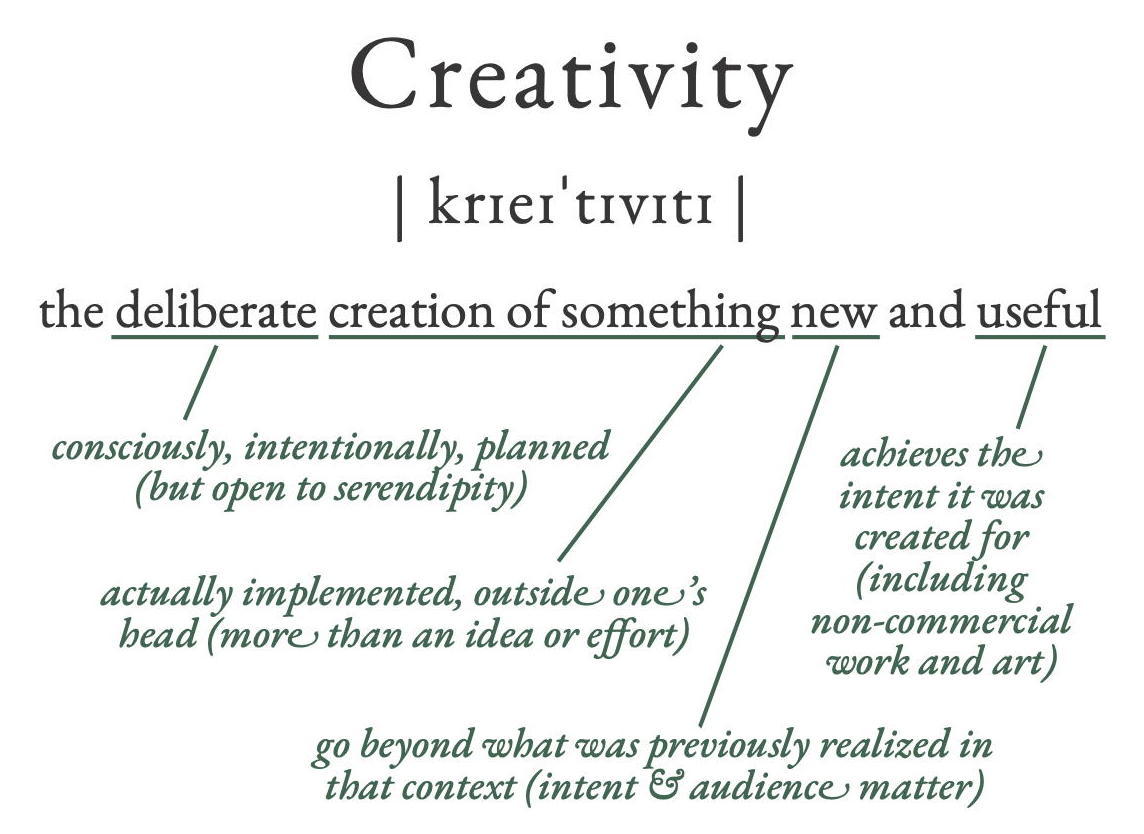
Defining Creativity
In this book, creativity is defined as the deliberate creation of something new and useful. This means:
- deliberate: You have an intention to create something.
- creation: You make something that exists outside your head and can be experienced or evaluated. It is externalized, structured output, finished or shippable work, or completed projects — not pure thought. This is required to see whether it works as intended.1
- something: Work, whether physical or immaterial, as long as it is externalized. For example, products, artifacts, theories, models, plays, improv performances, or music.
- new: It was not previously realized within the relevant context, which depends on intention and audience. For example, in a domain such as science or engineering, it must not have existed before — a very high bar. In a relationship, e.g., planning a romantic evening, it is sufficient that it is new within that relationship, i.e., new to the person.2
- useful: It has value — including non-commercial or artistic value. This value can be the original intention for which it was created, or value that emerges during the process of creating it. This also implies that an audience understands and can use it, though that audience may also be a future one (see Who Judges Creativity on page 17).3
This definition includes a wide range of creative work — scientific discoveries, engineering, art, business, creative gifts for a partner or friend, and much more. The time from initial idea to realized project can range from a few minutes (e.g., spontaneously arranging flowers in a certain way) to decades (e.g., the Large Hadron Collider). The costs can range from virtually free (e.g., picking flowers) to extremely expensive (e.g., a mission to Mars).
Deliberate does not exclude accidental or serendipitous discoveries, happy accidents, associative drift, emergent creativity, or play that becomes productive. These can all be important starting points and are closely related to ideation, but they are not sufficient on their own. Usually, a deliberate effort is still needed — for example, to understand what was found or to turn it into something usable.4 Likewise, newness can include incremental advances, transformations, reinterpretations, parody, and radical paradigm shifts.
Some activities fall outside this definition because they do not produce externalized artifacts. Play (not deliberate) and having ideas (no creation) are important parts of the creative process, but not sufficient on their own. Similarly, copying or criticizing (not new), and madness or eccentricity for its own sake (not useful)5 are excluded. This also means that mediocre but existing work is more creative than unexecuted masterpieces. And that neither a profound but unrealized internal breakthrough nor a brilliant process with no output counts as creative. That is intentional — creativity is not only thinking, it is realized work.
Overall, this definition is closer to craft traditions. It makes creativity production-oriented and behavior-based. It is something we do, something that leaves traces — not something we claim to be.6
Because this definition focuses on realized, behavior-based work, it dissolves a great deal of self-deception and makes improvement testable — change behavior and observe the output. This production includes the foundation, ideas, creative focus, and project work. That is why this book and its supplemental materials focus on adjusting behaviors and systems rather than cultivating traits or inspiration. It is also why the following chapters examine the structure that already exists in your work, and how small changes to it can be tested.
While this may appear outcome-oriented, it is concerned with the practical consequences of trying to improve your creative system — increasing the quality and quantity of the new and useful things that are deliberately created. That is the criterion against which any change is ultimately measured: Is there a sustained increase in realized, functioning artifacts under real conditions?
Who Judges Creativity
The terms new and useful are judgments. This raises the question: Who makes them?
A model proposed by Csikszentmihalyi provides useful guidance here.7
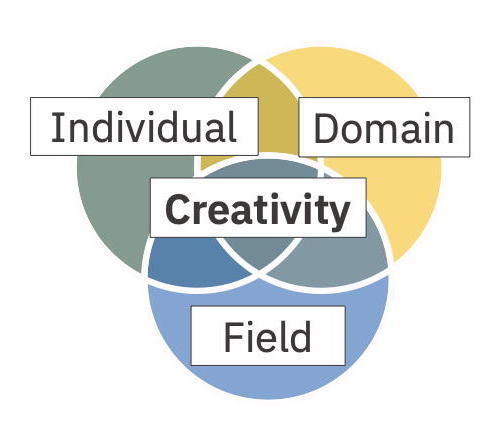
According to it, creativity happens in the interaction between
- the individual: the person who is doing the work — e.g., you or your team,
- the domain: where the creative work is situated, the structured body of prior work and standards — e.g., science and its subdomains, engineering, business, art, specific social groups, or the interpersonal level for creative gifts, and
- the field: those who evaluate the work regarding newness and usefulness, and often determine recognition.8 Sometimes the field also controls access to resources, such as grant money, or to distribution channels, such as galleries or scientific journals. In this book, the field is the target group or its gatekeepers, e.g., the professional community in science, small groups, a single person, or even just yourself.
Because creativity is determined within this interaction, it does not depend on a single factor, nor is it fixed. Individual, domain, and field all help determine whether something counts as creative, and all three can change over time.
For example, we often think of specific people as creative — Leonardo da Vinci, Thomas Edison, Nikola Tesla, Vincent van Gogh. And rightly so — they deserve recognition as inventors and artists of the highest order.
However, this view tends to ignore the environment in which they lived and worked — the available knowledge and technology, the infrastructure, the influence of other people, the zeitgeist, and the state of the domain itself, e.g., the open questions, materials, and pressures they had to work with. One way to see this is in parallel creativity, when multiple people independently develop the same thing (e.g., both Charles Darwin and Alfred Russel Wallace independently developed the theory of evolution by natural selection).
The field that judges the work can also change. For example, during his lifetime van Gogh’s paintings were not regarded as creative and he sold only one. Now they are loved by millions. The judgment of the field changed.9
Domains and fields vary widely — in size, structure, methods, materials, openness, visibility, and internal standards. They also determine which modes of being creative are valued and which are not.
Compare, for example, a research scientist writing a scientific article after a year of experiments with an improviser performing live on stage (e.g., improv theater). Both are creative, but they work in very different worlds. The scientist has enormous time flexibility, long feedback cycles, papers as stable artifacts, revision upon revision, and supportive external memory with notes, drafts, and statistical analyses. The improviser has immediate time pressure, dense sensory feedback, no ability to revise, no persistence of the artifact, and a live audience whose energy changes everything. Thus, the domain and field afford very different forms of thinking, making, imagining, and deciding. They determine what is correct, what is rewarded and punished, and what works and what does not.
This means that the affordances of domain and field shape your ability to do creative work. You need to know the domain — for example, psychology, or more specifically social psychology — in order to determine which problems are worth solving, to have material to work with, and to notice when you have created something genuinely new. You also need to consider the field, because those in it determine what counts as useful and therefore whether your contribution is valued. And your own way of thinking, making, imagining, and deciding must fit both.
Even within the same domain, the field can differ depending on what you create. If you write a scientific paper, the field consists mainly of other scientists — especially editors and peer reviewers — who determine journal acceptance. If you write a popular-science book, editors are usually the key gatekeepers. If you self-publish — books, blog posts, online videos — the public itself becomes the field, without intermediaries. Scientific papers require more rigor, but the others can generate far more visibility.
Because many problems do not fit neatly into disciplinary silos, important creative solutions often emerge from the interplay of different domains, i.e., interdisciplinary work. However, because multiple fields are involved, recognition is often harder. Each field applies its own quality standards and may be confused by the material of the other domain.
These three aspects — individual, domain, and field — are examined more deeply in the Foundation part of the book — the individual in Person, the field in Environment, and the domain in Capabilities.
Costs and Benefits of Being Creative
Creativity is not inherently beneficial to the creative person. It takes a great deal of time and effort to learn a domain and realize projects, often under conditions of frustration and uncertainty — for example during creative droughts or when you have to «embrace the suck». In some areas, you also face open resistance, ostracism, or personal danger — from people threatened by change or by different points of view. In some cases, the dangers are inherent to the domain itself — think of Marie Curie’s radiation experiments.
Creativity is also value-neutral. It can be used for benign goals — enlarging our options, improving the world, or simply making life a little better. But it is not limited to these ends, and creative work is not always used for benign purposes. For example, addictive systems or terrorist attacks can be new and useful for their creators’ purposes.10 Because the work itself cannot bear responsibility for the ends, means, and consequences, ethically, that responsibility falls on the creative person.
So there is a serious responsibility in what you create and how you create it, and that responsibility cannot be delegated away. As Yeats put it, «In dreams begin responsibilities.» This includes the problems you choose to solve, how you test whether your work actually functions as intended, and its side effects and long-term consequences. While that responsibility applies especially strongly in scientific research and product development, it extends all the way down to one-on-one interactions. Even gifts come with obligations and change relationships. And unfortunately, good intentions do not protect against ethical failure. On the contrary, they are often used to evade ethical scrutiny.11
Finally, while you can increase the likelihood of successful creative projects, creative work always carries the possibility of failure. Nobody can guarantee success. Even if everything works out, someone else may beat you to it (Parallel Creativity), or the field may change. Creative work is high investment and high risk — with no guaranteed return, and with the real possibility that even hard-working, talented people fail to make a meaningful impact.
Still, if you are willing to bear the costs, creative work can provide meaning, satisfy the creative urge, create a sense of accomplishment, bring fun, and sometimes even fame or fortune. It also gives you the chance to use your full powers — knowledge, imagination, skill — in pursuit of something difficult and worthwhile.
Few things are more satisfying.
Changing the Cost-Benefit Ratio
The costs and benefits of creative work are not fixed. We can change the conditions under which creative work is attempted. And creative people have always tried to shift the balance in their favor, usually by organizing their work and improving the infrastructure around it.
Thomas Alva Edison, for example, was not merely a solitary inventor. He also led an industrial research lab — an organized approach to technological innovation. Scientists write down ideas, flesh them out, and document progress, because the work is too complex to rely on memory. Even many «accidental» discoveries were only possible because the work was done with enough organization and care for something unexpected to stand out. Writers use outlines to make writing manageable. Painters sketch. Even artistic inspiration and scientific insight benefit from organization — not because they can be organized directly, but because favorable conditions for them can be created. On a smaller scale, even surprising someone with a gift often becomes better when the idea is captured and worked on.
So science, engineering, art, inspiration, insight, and small creative projects all benefit immensely from good organization. It makes serious creative work possible and raises its quality level.
Because creative work involves so much more than capturing ideas or structuring tasks, the next chapter introduces the broader framework that approaches creativity in a more holistic way.
Endnotes
- Most creative people are also very good at imagining that their ideas work. The test of whether it actually works can only be done by reality. ↩
- A useful distinction here is between psychological creativity (new to the individual) and historical creativity (new to the domain). The latter matters mainly when contributing to a domain such as science, engineering, or art — and is essential for patents. But requiring every creative act to be historically new would be one of the fastest ways to stifle creativity. ↩
- There is work that is ahead of its time, misunderstood initially, or appreciated only by a niche — and that is fine. However, being «ahead of his time» or «misunderstood» should not become the only explanation for why work is not accepted. Perhaps the issue is not in the audience, and the person is not a van Gogh. He might be a Semmelweis, or worse, «Bozo the Clown» (via Carl Sagan). ↩
- For example, other researchers noticed the relevant properties of certain molds that could have led to Penicillin, but Alexander Fleming took the necessary steps that led to its discovery. Same with other «accidental discoveries» — it is one thing to notice something interesting, another thing to create something new and useful from it. ↩
- In creative people, eccentricity is the result of a strong work focus and thus highly functional. It allows them to work on a high level. It is not an identity or something someone chooses to «be creative». See also the supplemental materials. ↩
- This view is different from seeing creativity as imagination, originality, personality, self-expression, or ideation. They are very appealing, but without realization they are akin to nice dreams. ↩
- Csikszentmihalyi (1996). ↩
- The field consists of those who judge whether the work has merit. In this book, «field» includes both gatekeepers and target audience, because both matter. If only gatekeepers see the value, the work may be available but unused. If only the audience sees the value, it may never reach them. In some private or self-directed cases, the field may shrink to a single evaluator, including the creator when you do something for yourself. ↩
- Csikszentmihalyi (1996). ↩
- Including, for example, weapons and weapon design. As force multipliers they can be used for good and bad purposes, e.g., from defense against an aggressor, to murder, terrorism, and wars of aggression. Creativity just makes it new and useful, e.g., force is applied where intended. ↩
- The issue of «good intentions» usually only arises as an attempted defense when things might go or did go seriously wrong. For example, side-effects or long-term effects make the situation much worse, or individual agency was ignored. There is a reason why «the road to hell is paved with good intentions» and even the worst people in history justified to themselves that their «intentions were good». This makes «good intentions» a warning sign, not a justification, and a way to justify unethical behavior up to the worst atrocities, not prevent them. «Good intentions» are a huge red flag. ↩
Supplemental Materials
OC3 Navi
- Home | Front Matter
- Why Organize Creativity
- Creativity as a System: 1. Creativity, 2. Creative System, 3. Application, Meta: Supplemental Materials
- Framework: Foundation: 4. Person, 5. Environment, 6. Capabilities, Meta: Tools
- Framework: Ideas: 7. Generating Ideas, 8. Capturing Ideas, 9. Collecting Ideas
- Framework: Creative Focus: 10. Creative Direction, 11. Creative Energy, 12. Creative Commitment
- Framework: Projects: 13. Project Realization, 14. Project Evaluation, 15. Project Release
- Back Matter: Afterword by the Author, Afterword by AI, Sources and Foundations, References, About the Author, Feedback and Saying Thanks, Glossary, Appendix