Archive

Posts Tagged ‘meta’

Draft Version of Organizing Creativity 2nd Edition

January 11th, 2012 No comments

Hey everyone,

I’m still working on the second edition of Organizing Creativity.

It takes longer than expected (it is a spare time project), so, I’m putting the current draft version online.

sample_page_oc2_0

It contains the content of the wiki I had here, so I have removed it.

Like I said, it’s a rough draft — some parts are (almost) finished, others are missing in part or completely — but to make the best of the longer work process, posting it online gives me the opportunity to ask for feedback. This is your chance to influence the final version. What do you think of the content and/or the layout? Any suggestions for improvement? I’d like to hear them. Drop me a line at danwessel@organizingcreativity.com or write a comment.

All the best

Daniel

Happy New Year and Outlook for 2012

January 2nd, 2012 No comments

After a rather strenuous ending of 2011, 2012 is finally here — so here’s a short outlook (I wouldn’t call it resolution) for this blog.

number-of-words2012 will bring a new version of Organizing Creativity. I’ve finally moved the content to InDesign, so the final phase (some rewriting, a little resorting probably, shortening the text and sharpening the language) has begun. All it all, the design looks good and — at the moment — the word count is nearly halved (see diagram with the number of words on the right side). I hoped for only a quarter of the amount of words compared to the first edition, but I put in some new content, so that’s fine.

Besides the new version, which will take up most of my spare time reserved for OC, I will also try to post more frequently. There are some good programs, Apps and Tips out there, and it’s a shame to do creative (or any) ineffectively.

All the best

Daniel

Categories: General Information Tags:

Poster: How to Organize Your Creativity?

October 13th, 2011 6 comments

I have translated the poster I did for the MinD-Akademie 2011 in English. I love it — it shows on one (very large) page the whole concept that I try to convey with “Organizing Creativity”. If you prefer it in German find the German version here.

I will probably do a similar version for the second version of the Organizing Creativity Book (still working on it) and use it as navigation help for the Organizing Creativity Wiki (likewise still working on it). But until both are ready, have fun with this poster (note: due to the size — DIN A0 — it is about 7 MB).

oc-poster-englishThe poster shows the different steps that are necessary in organizing creativity. While the process goes top down (yellow arrow in the horizontal center), each step is also another occupation with the topic (yellow arrows upwards to occupation with the topic), which leads to further ideas. I have left the footer for the moment — in case you are wondering it translates as “MinD-Academy 2011 — Future and Research”.

Poster: Wie organisiert man seine Kreativität? [German]

October 3rd, 2011 5 comments

English Note: This posting is about a poster I did submit to the MinD-Akademie 2011, showing on one (very large) page how one can organize one’s creativity. It was accepted and well received. The poster is in German, but I will do a translation soon. [Update: Translation is finished and available in this posting here.]

MinD-Akademie 2011 Poster

Das Poster zeigt die verschiedenen Punkte die wichtig sind, um Kreativität zu organisieren. Während der Prozess von oben nach unten läuft, ist jeder Punkt auch eine Beschäftigung mit dem Thema (gelbe Pfeile nach oben) und führt entsprechend zu weiteren Ideen (mittige Pfeile nach unten). Auf das Poster oder hier klicken, um das Poster als PDF in DIN-A0 zu sehen (die Bilder selbst sind runterskaliert, so dass die Datei “nur” ca. 7 MB groß ist). Die Datei ist in der Dateigröße reduziert, die Bilder sollten aber trotzdem in druckbarer Qualität sein. Das Poster, das ich ausgestellt hatte, habe ich in Hannover gelassen (vielleicht hat es ja ein nettes Heim gefunden, sonst wurde es halt entsorgt). Ich musste los, habe mein Poster nicht gesehen (oder ich war grad blind) und ich habe mich auch von einigen Leuten nicht (bzw. nicht richtig) verabschieden können (war auch was k.o., auch wenn’s/weil’s riesigen Spaß gemacht hat). Ich hoffe, ich sehe ein paar Personen bald wieder, auch gerne mal zu Besuch in Tübingen, auch wenn ich die Namen grad nicht verfügbar habe (ich denke, ich habe den Networking-Workshop wirklich gebraucht — war gut und eine gute Erinnerung).  Ich wünschte halt, ich hätte mir die Namen notiert, von den Personen, mit denen ich interessante Unterhaltungen geführt hatte (hmm, in der Badewanne eben gab’s eine nette Idee für eine App bzw. die Fortführung einer älteren Idee dazu  … ;-) ).

Traffic Plus

August 24th, 2011 No comments

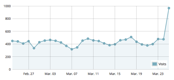
I have written a few postings about DEVONthink (I like this one here most), but it was a metaphor, comparing DEVONthink to the U.S.S. Enterprise that made it into the DEVONthink company blog. Strange … but effective — it lead to an immediate traffic plus:

traffic_plus

It’s great, but also a little bit of bad timing, as I am currently working on the second version of the “Organizing Creativity” book (more concise, more practical, better layout), which will combined by a Wiki (only for information display, not for collaborative editing — it will provide direct access to information without having to sift through chronological blog entries). It think it will be useful and beautiful, but it will likely take me two or three months until it is finished.

So, if you just came via the DEVONthink blog or just dropped by for other reasons, you might find something (more) interesting here in a few months.

Until then, enjoy the entries here — I hope you find something useful for you.

Thank You :-)

May 4th, 2011 No comments

“Why do some people act as if making money offended their delicate minds? I am out for a legitimate profit, and not ashamed of it; the fact that people will pay money for my goods and services shows that my work is useful.”
“Magic Inc.” by Robert A. Heinlein

Today a check from CreateSpace arrived — the first payment I’ve ever received from them:

check

So, at least some people thought the book I wrote might be interesting or useful for them. Given that the whole book is available for free here (also here as PDF), I hope they bought it because they liked it and just wanted to have it on paper.

As usual I am very interested in feedback, but for the moment I just want to say: Thank you! :-)

I didn’t write the book for the money but it’s nice to be appreciated. :-)

Sorry, work is insane at the moment

April 27th, 2011 No comments

Dilbert.comA great Dilbert cartoon from today.

I haven’t forgotten this blog and there are some postings I’m dying to write, especially about some web tools and some literature management, but at the moment, work is insane … well, a mixture of insanely fun and insanely … insane.

Sorry if the postings will take a while.

Perhaps I need a question section …

February 6th, 2011 No comments

Sometimes readers send me questions, usually as comments, but a few times they have used the Organizing Creativity Questionnaire for this. While this is also possible and I get the text as eMail, the problem is that this questionnaire is anonymous. Which means, if the reader didn’t leave his eMail address in the text, I cannot reply.

I have answered the latest question by copying the text as comment to a fitting posting and answering it there. So, Chris, if you like to read the reply, it’s below the posting: How to Write a Dissertation Thesis in a Month: Outlines, Outlines, Outlines. ;-)

Pushing Rope Day

January 12th, 2011 No comments

“I’ve got to concentrate… [his thoughts echo] concentrate… concentrate… I’ve got to concentrate… concentrate… concentrate… Hello?… hello… hello… Echo… echo… echo… Pinch hitting for Pedro Borbon… Manny Mota… Mota… Mota…”
Ted Striker, thinking to himself, in Airplane! (1980)

Yesterday was one of these “pushing rope” days — no matter what you start you cannot concentrate on it for more than a few seconds. It’s like the Chaos logo of Warhammer — arrows going out from a center point in all directions — thoughts are absolutely unfocused and cannot concentrate on one point.

After realizing this I did what I would do when I cannot do a specific task on a creative project — I switched to another group of tasks. I started to do those little tasks that I have to do, but are usually not done until the very last moment. Things like up/downloading the presentations of my course, adding some information to my wiki, going through some files, sorting literature, etc. I went early (i.e., on time) and went to the hairdresser (something I had to do for a long time). When I got home I continued with these little tasks (for me, a “pushing rope” day makes no difference between work and private projects), for example, I finally lowered a side board by replacing the original pillars with two boxes of 2500 pages of white paper (one process in the back of my brain was searching for something to replace the pillars with, and it mentioned that the boxes we have at work would fit, so I ordered the cheapest paper I could find on Amazon, had it delivered to my home — and hey, it worked! ;-) ), found a way to reenter my apartment without removing my shoes if I have forgotten something, etc. pp.

At least it was still a productive day (and I don’t feel like a fraud at work), but I am curious — What do you do when you know that you cannot concentrate on (the main part of) your work?

63 Theses about Creativity

December 18th, 2010 No comments

I have written down my position on creativity (Version 1.1) — heavily guided by the chapters and contents of my book. It reduces the 400 pages to 4 1/2. You can also find the 63 Theses about Creativity as a PDF file here. Note: Some theses are based on Csikszentmihalyi (1997) and Runco (2007).

Creativity

1. Creativity is the realization of new and useful ideas. Ideas without implementation are not creative, neither are new things that are not useful. Usefulness means that it achieves (or helps to achieve) a goal that is set in advance. There are many misconceptions about creativity and many people who claim they are creative, however, creativity is visible in the artifact and thus there is no need for creativity to be claimed, it can be seen and assessed.

2. Creativity happens in the interaction of an individual (e.g., a scientist), a domain (e.g., physics), and the field (e.g., other scientists).

3. Given that creativity is an attribution of the field to the contribution of an individual to a domain, what is regarded as creative can change over time.

4. Individuals, domains, and fields differ – for example, the individual in abilities and acquired knowledge, the domains in size, structure, material and methods, and the field in influence, homogeneity and openness.

5. The domain must be learned before one can be creative and contribute to the domain.

6. The field filters the input of individuals to the domain by deciding which contributions are creative and are added to the domain. It can also control access to resources (e.g., rare equipment) or distribution channels (e.g., galleries). Often, the strength of the field varies over time and place.

7. Creativity is not madness (it is new, but useful for something), it is not defined by accessories or tools (it is the work that counts), it is not destruction (criticism is not creative unless it makes a contribution to something new), it is not fixed (the interplay of individual, domain and field is highly erratic as all three aspects change over time), it is not easy (you have to work extremely hard to learn the domain and skills and to realize your ideas), and it is not yours alone (parallel creativity, i.e., two people creating the same object independently from each other, happens).

8. Creativity is neither inherently positive or negative – it is new and useful to achieve a goal, whether this goal is positive or negative. On the positive side, creativity can be fun to do, bring fame and remembrance, satisfy the inherent need to be creative, advance society be enlarging mankind’s options, improve mankind, and bring fun to others. On the negative side it can lead to open resistance and personal danger, isolation, and to disadvantages for society due to negative effects of science (e.g., DDT) and art (e.g., propaganda/advertising).

9. If you are creative you have to take responsibility for your creative contributions: think about what you do, scrutinize the consequences and be on the lookout for side-effects, educate the public, communicate clearly, and in the worst case destroy your work or blow the whistle and inform the public.

10. Needed to be creative are motivation (e.g., curiosity, goals, interest, fun, frustration tolerance, determination and persistence, focus), education and training (e.g., knowledge, skills), an effective work style (e.g., self reflection, hard work, autonomy, discipline, good habits), attitude towards the subject (e.g., naivety, seeing what else it could be, flexibility, ambiguity tolerance, open mindedness, controlled madness, humor), interaction with others (e.g., remaining yourself, courage, feedback, support, discretion), and structural requirements (e.g., time, money). However, neither age alone, nor genius level intelligence, or sponsorship is usually needed.

Creativity and Organization

11. Creativity must be organized because it is more than just one idea. A creative project consists of multiple ideas (e.g., the idea for a book consists of countless ideas for setting, characters, dialogues, quotations, objects, etc.) that cannot be remembered all or be easily available at once when needed.

12. Ideas must be captured (recorded immediately when they occur) and collected (long-term storage that has an inherent order).

13. Organizing creativity has the advantages of, for example, stimulating new ideas, making things easier or enabling them, providing a clearer structure, fewer mistakes, facilitating the development of ideas, and protection against plagiarism.

14. While there is a myth of accidental discoveries, the situation would not have been occurred unless the person was experimenting on a high level and it would not have been noticed unless the creative person was able to make sense of them. Actual work and extensive knowledge are necessary for creativity.

15. Creativity needs an infrastructure to generate, capture, collect, develop and realize ideas.

16. The danger is having a weak or ineffective infrastructure or over-organizing creativity be placing to much attention on the tools. Tools and technology do not have a value in themselves, they are a means to a specific end: to realizing creative ideas.

17. Work spaces should keep physical, virtual, and mental interruptions to a minimum. This may mean, for example, locking the door and turning off Internet access and the cellphone.

18. Time is needed to be creative and this needs to be organized. You have to keep and defend your time to work frequently and over long time frames on a project.

Generating Ideas

19. To generate ideas you have to occupy yourself with the subject, have time for incubation, recognize insights (ideas), evaluate and elaborate them.

20. Generating ideas needs a lot of hard, tedious and sometimes boring work – and time to do this. To be creative one has to learn, experience, practice, and persist. Learning a domain needs years of hard work, for example, if 10.000 hours are needed to reach expertise this means 27.4 years(!) if one hour each day is used. A normal working day of eight hours will take about three and a half years (about the duration of a dissertation).

21. Time for incubation is needed that is not used in interaction with people, toys, or games. Good situations are walking and bathing, before sleeping and after waking up, boring presentations, and traveling alone.

22. Blocks might occur while generating ideas because the aims are not clearly defined or the necessary knowledge is missing.

23. Techniques and tactics exist to stimulate the generation of ideas, however, a working knowledge of the domain has to be acquired first. While there is no silver bullet, they might help by breaking the routine and providing an excuse to spend time on thinking, but they cannot work without the necessary foundation of knowledge.

24. Structural strategies are, for example, keeping one’s independence, having time for ideas, seeking solitude, being open and prepared, looking at the world with a sense of wonder, doing one’s own thing, following one’s inner voice, breaking routines, and following ideas.

25. Perspective strategies are challenging assumptions, changing the approach, questioning one’s methods, considering the exceptions and fuzzy borders, looking where no one else is looking, turning the situation upside down, considering trivially, asking questions, looking at the big picture, describing the problem differently, laying the problem out, considering the details, looking at the data, looking at an individual case, breaking it down, simplifying the problem, looking the core of things, and going further.

26. Inspiration strategies are looking for inspiration in existing works, e.g., via analogies, associations, previous ideas, forced relationships, unfinished works, or considering the natural world, having supportive and inspiring experiences, looking at ones mistakes, improving the infrastructure, surrounding oneself with different people, and improving ones tools.

27. Getting help strategies include surrounding oneself with smart and creative people, brainstorming, Delphi-method, work in heterogeneous teams, expert opinions, getting a partner, talking to the ones at the basis, talking to people without opinion or knowledge, and arguing.

28. Distance strategies increase the distance by taking a step back or decrease the distance by working harder.

29. Change of options strategies reduce, e.g., by constraining work or field of activity, or enlarge the options, e.g., by deviations from reality, changes in material and methods.

30. Changing yourself strategies include getting in a positive mood, aligning tasks to moods, dreaming, drugs, controlled madness, keeping an untidy mind, and keeping a paracosmos.

31. Just do it strategies include producing a lot, experimenting, deviation amplification, or “simply” trying it.

32. Harder than solving problems is finding problems, although strategies exist like changing the domain, considering the future, looking at the past, continuing where others have failed, looking at the world, finding a need, thinking different, taking part in a contest.

Capturing Ideas

33. There are many reasons why people do not capture ideas, but there are no good reasons. Ideas should be captured so that nothing gets lost, resources are freed, stimulate more and better ideas, allow for conscious and deliberate quality control, and to cartograph the river of thoughts.

34. Ideas should be captured immediately, always, fast, effortlessly, without concern for sorting them, allowing exploration of the idea, with simply, flexible methods and techniques, and understandable at a later time.

35. Factors determining if an idea gets captured are the objective, subjective, social and physical costs of the medium, the specific demands of the environment, the specific value of the idea, the general value of ideas, and the available tools to capture the idea.

36. The capture rate can be increased by keeping something to capture immediately available, getting the right attitude, getting cheap materials, optimizing the infrastructure, and by capturing first and collecting later.

37. Criteria for evaluating idea capturing methods are availability, speed of access, ease of use, flexibility, and ruggedness. There is no ‘best’ tool as its value is dependent on the user, the situation and the content to be captured. High quality of a tool can be a disadvantage if it prevents capturing “stupid” ideas – a tool should never become more important than the cheapest idea.

38. If ideas are missed it is possible to get them back by retracing the steps, reducing anxiety, and trying again later.

39. Ways to capture ideas include pen and paper, stationary ways like blackboards, whiteboards, MagicCharts, FlipFrames, or Smartboards, and digital ways like cellphones, smartphones, PDAs, voice recorders, (video) cameras, scanners, and PCs.

40. Other people can be serious barriers to capturing ideas in public, however, there are strategies to deal with this, e.g., by making them believe they know what one writes, writing for a long time, or using a smartphone.

41. Typical situations for capturing ideas are on the move by foot, by car, as a passenger, in bed, in the shower, in the bathtub, during sports, at the computer, at work and at home. There are ways to improve capturing ideas in each situation.

Collecting Ideas

42. Ideas must be collected to have the ideas available when needed. A huge box with snippets of paper which contain ideas is worthless because it is not useable. There must be one and only one idea collection where all ideas end up.

43. An idea collection must be systematic – its goal is to support the realization of creative ideas/projects. Its core functions are remembering (allowing stumbling over ideas), generating (stimulating new ideas), finding (without or with easy search), enlarging (easily adding new information), and restructuring (easily changing the structure).

44. To transfer the captured ideas to the collection a “collection inbox” can be used. It might be an input file or folder where ideas are collected one after the other from different capturing tools and then transferred into the idea collection.

45. An idea collection must be regularly cultivated to keep it useful.

46. Tags are very useful for idea collections, a taglist might include tags like: related projects, area of creativity, quality, usage, media attachment, idea origin, target group, purpose, time/place, task information, and other specific tags.

47. Idea collections can be ordered alphabetical, thematically, chronologically, via index numbers, or by multiple principles.

48. A common problem is that a person has too many interests and wants to realize too many ideas. Prioritization is helpful by determining one core project (currently realized), a selected handful of central projects (highly interesting proj¬ects with intensive idea gathering), and by default looking at the rest as periphery projects. The idea collection should reduce pressure to realize all ideas at once, because ideas not currently realized are stored and cannot be forgotten.

49. Idea collections can be evaluated according to their usability (including ease of use – speed, backups, look and feel, flexibility, media compatibility, and availability), the ‘big five’ (remembering ideas, generating ideas, finding ideas, expanding ideas, and restructuring ideas), and security (future proof, access control, data security, and data control). Most collections can be adapted to the individual user’s needs.

50. Ways to collect ideas include paper in variable order (e.g., index cards, file folders, loose leaf collections) and fixed order (e.g., notebooks, diaries, calendars), stationary ways in variable order (e.g., post-its, pinboards, magnet boards) and fixed order (e.g., whiteboard, blackboard, MagicChart, posters), and digital ways (e.g., files and folders, text files, mind/concept maps, outliners, digital notebooks, notes management systems, wikis, word processors, databases, spreadsheets, eMail-programs, and blogs. There are ways to improve each collection, in general and regarding issues like finding, expanding, restructuring and removing ideas.

51. To start an idea collection different methods to collect ideas should be tested first, new ideas should be entered first, and during draughts ideas from old collections can be entered.

52. An idea collection must be protected. The dangers vary whether it is analog or digital, but all collections are vulnerable to total loss.

Realizing Ideas

53. When new ideas are entered into the idea collection, the ideas ripe over time until they become ready to be realized. Only one project should be realized at the same time.

54. The project best to realize depends on individual factors (like skills, talents, knowledge available for the project, sufficient resources, motivation, importance of the project for the personal career), the field (e.g., the field expects and values the project, the field has an urgent need for the project), and the domain (e.g., the idea is really new, powerful, and the project in general is complete).

55. Realizing projects needs hard work and time – and determination to continue working on the project even if the work gets boring or tricky.

56. Realizing an idea consists of restructuring the idea in a logical order, reviewing the scope of the project, planning the realization, preparing everything before starting, getting the right tools, steady regular work, and evaluating the project.

57. Feedback is crucial. There is one and only one goal of feedback: the improvement of the work. Good feedback leads to improvement in the current and future work, bad feedback provides only support, is outsourcing, destructive, pure public recognition, or power play. It should be actively searched for when, and only when, the creative needs feedback.

58. To communicate ideas they have to be adapted to the target audience by someone who knows the field. The opinion leaders should be convinced and promoters should be acquired. The idea must be clear, simple, and concise to get the gist across.

59. Worst cases in creativity include parallel creativity, loss of the job, having the field against oneself, failure, non-realizable ideas, too many implementable ideas, being not good enough, and death.

Archiving Ideas

60. Creative projects consisting of many ideas should be archived for remembrance, motivation and inspiration, enabling to revisit past projects, learning from mistakes, and creating a portfolio.

61. A copy of the work itself, meta information (like time, purpose, procedure and materials, evaluation, and inspiration), idea history, feedback and reviews, and personal records should be archived.

62. The idea collection can be used for archiving ideas.

63. The archive must be future proof and the size of the archive possible to handle.

Notes

If you want more information on these theses, read the book (here as PDF). If I have time, I’ll directly link the theses to the sections there.

Literature that was used for a few of these theses:

  • Csikszentmihalyi, M. (1997). Creativity. New York: Harper Collins.
  • Runco, M. A. (2007). Creativity. Burlington, MA: Elsevier Academic Press.