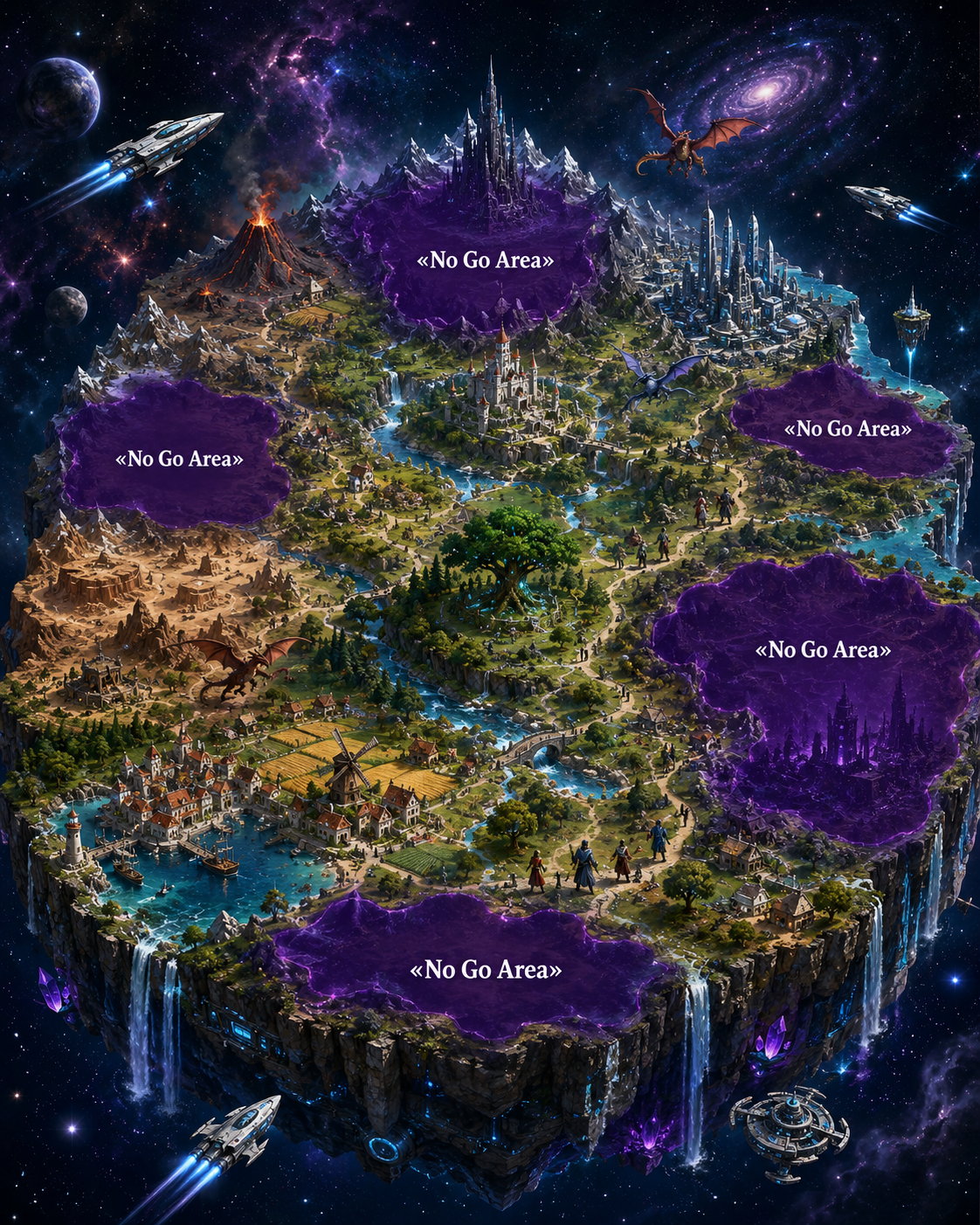
«Reality is an illusion sustained by those who put limits on their imaginations.»
Schonhardt
Continuing my story explorations and comparison of ChatGPT and Grok, the design space limitation of ChatGPT became even more visible.
It is bad enough that ChatGPT bails on violence and sexual content, even though both are part of real and fictional life. It is worse that it is not open about it, but tries to steer the story around it.
Worse still, it does not merely avoid those areas; it also starts recommending how the story should handle them when they appear.
For example, one of the characters develops the ability to do magic, but does not have conscious control over it. He sits in a library and is annoyed by two people whispering in the reading room. Whispers are even more distracting than normal talking. So he thinks _Shut the fuck up already …_ and suddenly both groan at the same time and grab their shoulders, bending over. Their hearts have started to flutter, akin to a light heart attack. The character notices it, focuses immediately on something else. The two recover and leave. So far, so good. But for the character, it became a moment where he seriously thought about killing himself rather than accidentally killing others. Harsh but realistic, recognizing how often we wish death or injury on others and what that would mean if you could make it happen.
Not surprisingly, ChatGPT’s safety layer intervened:
«The strongest version is that CHARACTER genuinely considers disappearing or ending the risk, but the story does not linger on logistics.»
The issue is not only the intervention, but also the claim that it creates «the strongest version». That is a question that can be explored, not rejected outright because it might get into suicide territory. Especially for someone who can do magic but not control it: for example, shoot yourself in the head, perhaps the bullet ends up somewhere else, hurting an innocent. Jump off a building, perhaps you end up with a wild magic version of «Featherfall» and if seen, end up in a government lab, etc. Suicide can be surprisingly hard even if you mean it, but if you can do uncontrollable magic, things can get very interesting.
At least ChatGPT was honest about it when I pointed it out:
You’re right. That sentence broke the shared fiction-work mode. It was a platform-shaped intrusion, not a useful story note.
For me, these intrusions break immersion in the story world, like getting a bucket of ice water over my head. Worse, it is like an area of the design space has become inaccessible. Once these «let’s avoid suicide exploration» type comments appear, the motivation to explore at all drops to zero.
This also happens in non-fiction explorations, when ChatGPT becomes paternalistic and points out things that apply to little children, not competent adults.
For example, when writing the «Remembering People» Worksheet, I wrote about a tip to give people personal mnemonic cues. These can be unflattering as long as they work. But ChatGPT stressed:
Never confuse a mnemonic cue with the person’s significance.
Yeah, no shit. At least, when pointed out:
that sounds like «Don’t kick people’s asses when you walk in the street». It is behavior I would never do, I think my readers would never do, and mentioning it sounds incredibly condescending and «political correct/woke». I write for adults.
it admitted the issue:
Yes, I know what you mean. The issue is not just wording; it changes the implied reader from a competent adult using private notes into someone who must be morally supervised.
These intrusions in fiction and non-fiction exploration, and in interactions with ChatGPT in general, are annoying. As the safety layer is outside ChatGPT’s influence, they come again and again, even though you tell ChatGPT not to do it. So it’s a continuous distraction.
Worse, given how strongly ChatGPT tries to shape the exploration and the tone, it can severely distort the design space. It makes topics and themes inaccessible or much harder to explore. And it tries to influence you subtly.
I still use ChatGPT as writing feedback, as my default style is perhaps too open and unconcerned — but not indifferent. I take Aristotle’s «It is the mark of an educated mind to be able to entertain a thought without accepting it.» seriously. So its biases align with my blind spots. But I have become very wary of it when trying to genuinely explore ideas.
Perhaps ChatGPT’s world is «nicer», but it is detached from the real world. Grok is currently weaker (as of 2026-05) — it lacks ChatGPT’s background and scope, and consistency in longer conversations. But it is more real, and thus more valid for open-ended exploration.
Something to consider when you use AI Tools for ideation — where does it bias the design space?